
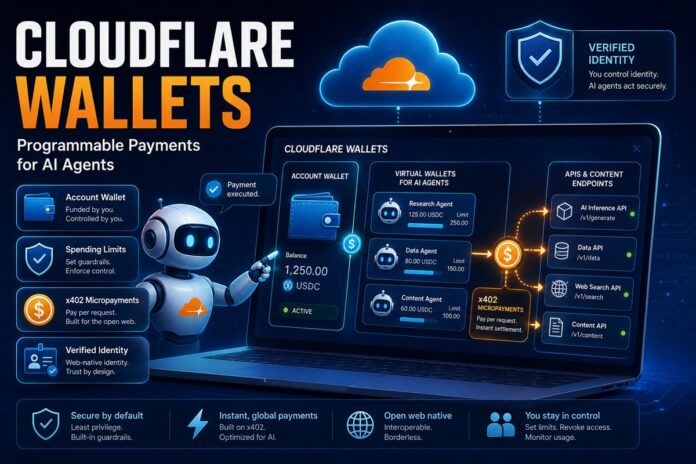

Cloudflare has launched Cloudflare Wallets, a programmable payment and identity system built specifically for AI agents on what the company calls the “agentic Internet.” Announced on August 4, 2026, the product lets AI agents pay for APIs and content on their own, within spending limits that humans set and control.
Right now, you can claim a Cloudflare Wallet handle for your account. The handle gives you a unique username for connecting with merchants. The ability to actually set up a wallet and pay for APIs and content is coming soon.
Here’s what launched, how it works, and why it matters for the future of agentic commerce.
What Are Cloudflare Wallets?
Cloudflare Wallets is a system that gives AI agents two things they have never reliably had: a native way to pay for services, and a stable identity on the web.
Today, when an AI agent tries to use a new API, it usually hits a wall. It has to navigate a login page designed for humans, ask a person to add a payment method, generate an API key, and then work out how to call the service. Agents frequently give up and hand the whole job back to a human, which slows down the growth of agentic commerce and makes it hard for agents to compare many services.
Cloudflare Wallets is designed to remove that friction. With a wallet, an agent can store stablecoins, purchase services, and receive funds across the web without a human stepping in for every transaction.
How Cloudflare Wallets Work: Account Wallets vs Virtual Wallets
There are two types of Cloudflare Wallets, and the split between them is the core of how the system stays safe.
Account Wallets are built for humans who own and use Cloudflare accounts. As the account owner, you can add funds, delegate spending to agents, and remove funds whenever you need to.
Virtual Wallets are built for agents and run on API keys. An agent spends from its Virtual Wallet according to the permissions it has been given, and its maximum spend is capped by a limit the Account Wallet owner sets.
This lets an agent act on your behalf without asking for approval on every purchase, while making it impossible for the agent to overspend your account.
You can define guardrails for each Virtual Wallet, including an allowance, an allow list of approved merchants, and a maximum transaction size. Those guardrails are what let you turn an agent loose to explore dozens or hundreds of APIs without worrying about a runaway bill.
The x402 Protocol Behind the Payments
Cloudflare Wallets is built on the x402 protocol, an open standard that attaches payments directly to HTTP requests. This is what makes agent micropayments possible: an agent can pay a few cents to try an API without creating an account first.

The wallets connect to Cloudflare’s Monetization Gateway, announced earlier in the same month, which lets Cloudflare customers get paid for their websites, APIs, and content.
Monetization Gateway is the “sell” side; Wallets is the “buy” side. Together, they form a two-sided, machine-native marketplace where agents pay for anything from AI inference to data to content using stablecoin micropayments.
If you want to pay or get paid through Monetization Gateway or other x402-compatible endpoints, you’ll need a wallet.
Safe Spending: Why Limits Give Agents More Freedom
Cloudflare frames spending caps as freedom rather than restriction, and the logic is worth understanding.
If an agent is responsible for $10, you can worry far less about its spending than if it controls $1,000. And because trying an API through x402 can cost just a few cents, $10 is more than enough for an agent to test and compare many options. The tight limit is exactly what makes it safe to let the agent explore on its own.
The controls scale to teams, too. Want to give every employee a $100-per-week budget for AI inference? You can fund an Account Wallet and create a Virtual Wallet for each employee with that rule built in. If someone hits their limit, they can request a manual override from a human authorized to change the Account Wallet.
The system is designed so you don’t have to monitor spending every day. If something unusual happens, such as unexpectedly fast spending, a human can review it and decide whether to raise the limit, approve a one-time top-up, or let the caps do their job.
Giving AI Agents a Verifiable Identity
Payments are only half of what Cloudflare is building. The other half is identity.
Right now, when an agent arrives at your website, you usually know very little about it, even though it is acting for a real person or organization. That breaks a lot of traditional web business models. It’s easy to offer a free trial or sign-up credit to a human, but hard to offer the same to an anonymous agent, especially when one person can spin up dozens of agents.
Cloudflare solves this by linking wallets to a Cloudflare account through cloudflare.pay. Agents can optionally identify themselves as a delegate of an account. A research agent might live at an address like research.example.cloudflare.pay, letting merchants see that it belongs to a specific organization. Declaring identity is completely optional, and it’s up to each business to decide whether it wants to prioritize dealing with known agents.
Cloudflare compares the approach to how the web treats VPNs: an unidentified user isn’t automatically untrustworthy, but they may need to prove themselves more. The identity layer builds on existing Cloudflare tools like Web Bot Auth, Turnstile, and Bot Management, turning a hard-to-read cryptographic key pair into a human-readable name, much like DNS maps domain names to IP addresses.
Why Cloudflare Wallets Matter
Cloudflare notes that a majority of web traffic is now driven by bots, which is the backdrop for this entire launch. The company is assembling the building blocks for agentic commerce to work end to end: Monetization Gateway so sellers can get paid without traditional payment infrastructure, Wallets so buyers can pay headlessly through agents, and identity so merchants can know who they’re dealing with.
For developers, startups, and businesses experimenting with AI agents, this points toward a near future where agents can independently discover, pay for, and use online services, all within limits their owners define. For anyone building or monetizing APIs and content, it’s an early signal of how machine-to-machine commerce may actually get paid for.
Frequently Asked Questions about Cloudflare Wallets
What is Cloudflare Wallets? Cloudflare Wallets is a programmable payment and identity system for AI agents. It lets agents store stablecoins, pay for APIs and content, and receive funds, all within spending guardrails set by a human account owner.
When did Cloudflare Wallets launch? Cloudflare announced Wallets on August 4, 2026. You can claim a wallet handle at cloudflare.pay right away, while the ability to set up wallets and pay for services is coming soon.
What is the difference between an Account Wallet and a Virtual Wallet? Account Wallets are for humans who own Cloudflare accounts and can add or remove funds and delegate spending. Virtual Wallets are for agents, run on API keys, and can only spend up to a limit set by the Account Wallet owner.
What is the x402 protocol? x402 is an open protocol that attaches payments to HTTP requests, enabling micropayments. It lets an AI agent pay small amounts, often just cents, to use an API without first creating an account.
Do I need a Cloudflare Wallet to use Monetization Gateway? Yes. To pay or get paid through Cloudflare’s Monetization Gateway or other x402-compatible endpoints, you’ll need a wallet.
How do spending limits make using agents safe? Account Wallet owners set guardrails on each Virtual Wallet, including an allowance, an allow list of approved merchants, and a maximum transaction size. These caps let agents explore and test many services autonomously while preventing overspending.