
Most brands treat getting cited by ChatGPT, Perplexity, and Google’s AI answers as a matter of luck. New research suggests it is closer to a counting problem, and the number is four.
Noble, a San Francisco-based platform that places brand mentions in the third-party sources AI models cite, published findings on August 31, 2026 identifying a threshold at which AI search visibility starts to stick rather than fade. The study analysed 599 brand mentions across 79 companies over an 18-week window, using live placements tracked from January to May 2026.
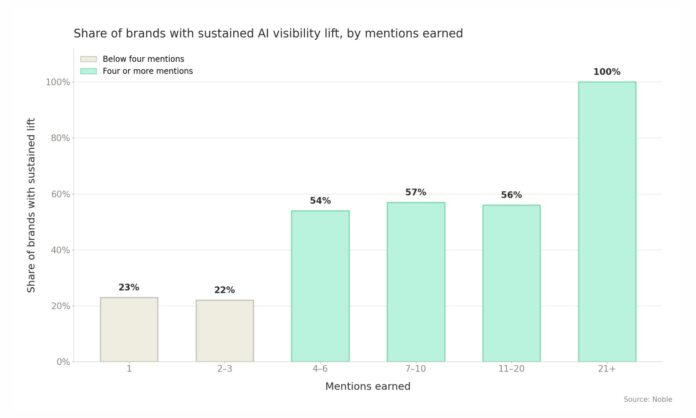
The headline result: only about a quarter of brands with one to three mentions kept their visibility gains through the study window. Once a brand reached four or more mentions, that share more than doubled.
What the research measured
Noble tracked whether brands appeared in AI-generated answers before and after offsite mentions went live, then checked whether any gains lasted through the end of the window. The distinction matters: a brand can surface in AI answers for a week and vanish again, which registers as a lift but not a durable one.
The study also ran a control group of 41 brands with no placements at all. The pattern held against that baseline, which is what separates this from the before-and-after case studies that dominate the AI search marketing space.
Noble puts the odds of the four-mention difference appearing by chance at roughly three in 1,000. The company describes the work as a preliminary look at the pattern rather than a settled finding.
The curve flattens after four
The more surprising number sits past the threshold. From four mentions through 20, the sustained-lift rate stayed in the mid-50s and did not climb further.
In other words, mentions five through twenty did not buy additional visibility. According to Noble’s Head of Content, Delia Rowland, they buy retention instead, sources can drop out of an engine’s rotation, and large language models tend to favour fresher material, so continued placement protects a position rather than extending it.
“Four gets you in. It doesn’t keep you there,”
Rowland said.
That framing has direct budget implications. A brand spending toward twenty placements expecting a linear climb in AI answer presence is, on this data, paying for insurance rather than growth.
Two client campaigns show the same shape
Noble pointed to two published client campaigns that follow the pattern.
The ABM Agency, an account-based marketing firm, registered no presence in AI answers through most of its 12 placements. Presence then jumped to roughly 12% within a single week in May 2026 and held at that level.

Zip, a $2.2 billion procurement platform trailing Coupa, SAP Ariba and Procurify in its category, moved from 29% to 52% presence in AI answers after 14 placements. Its share of voice rose from 11.2% to 19.1%, overtaking Procurify to reach third place in the category.
Both curves share a shape that will be familiar to anyone who has run a link-building or digital PR campaign: a long flat stretch that looks like failure, then a step change.
Why there is a two-to-three week lag
Rowland said the delay between placements going live and visibility shifting runs consistently across Noble’s client base at roughly two to three weeks, as models take time to discover a new source and treat it as trustworthy.
This is the practical detail most likely to change how teams operate. A campaign measured at day 10 will look like a failure. Programmes killed at the four-week mark may be killed one week after they started working.
The onsite-versus-offsite argument
The findings cut against how many marketing teams currently allocate AI visibility budgets, which lean heavily toward on-site work: structured data, schema markup, llms.txt files, FAQ blocks and content restructuring aimed at making a site easier for models to parse.
Rowland’s contention is that the most common misconception is assuming on-site content alone is enough to earn a citation, and that offsite is the lever most brands overlook.
It is worth stating the obvious caveat plainly: Noble sells offsite placements, and the research validates the service Noble sells. That does not make the numbers wrong — the control group and the significance testing are more rigour than most vendor research bothers with — but it does mean the study should be read as one input rather than as neutral evidence. Independent replication does not yet exist.
What this means for marketing teams
Four practical takeaways for anyone running generative engine optimization (GEO) or answer engine optimization (AEO) work:
- Plan in blocks of four, not one-offs. A single placement in a high-authority publication is, on this data, unlikely to produce a gain that survives.
- Do not measure before week three. Set the first checkpoint at 21 days minimum, and the real read at six weeks.
- Budget the back half as maintenance. Placements beyond the fourth are best justified as defending a position, not as buying incremental presence.
- Do not abandon on-site work. The study compares brands with and without placements; it does not test placements against on-site optimisation. Treating it as evidence that schema and site structure do not matter overreads the data.
Full methodology and both case studies are published on Noble’s resources page at thatsnoble.com/resources.
FAQ
How many brand mentions does it take to appear in AI search results? Noble’s research points to four offsite mentions as the threshold at which visibility gains hold. Below four, roughly a quarter of brands retained their gains; at four or more, that figure more than doubled.
How long does it take to get cited by ChatGPT or other AI models? Noble reports a consistent lag of about two to three weeks between a placement going live and visibility shifting, as models find and begin trusting the new source.
Do more mentions mean more AI visibility? Not beyond a point. Between four and twenty mentions, the sustained-lift rate stayed in the mid-50s without rising further. Additional placements appeared to protect the existing gain rather than grow it.
Is on-site AI optimisation still worth doing? The study does not test on-site work against offsite placements, so it offers no evidence either way. It compares brands with placements to a control group of 41 brands without them.
Who conducted the research? Noble, an offsite placement platform, published the study on August 31, 2026, through Newsfile. Because Noble sells the service the research supports, the findings warrant the same scrutiny as any vendor-published study.