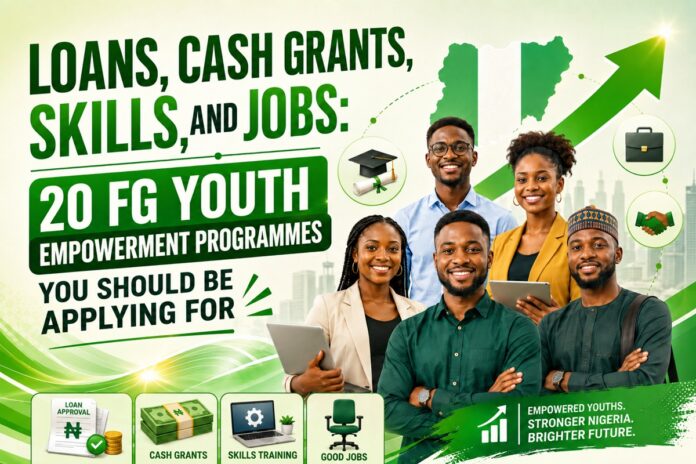
If you are a young Nigerian trying to fund your education, learn a tech skill, land a job, or raise capital for a business, here is something you may not fully realise: the Federal Government currently runs more youth empowerment programmes than at any point in recent memory. Interest-free student loans, free skills training with monthly stipends, ₦1 million startup grants, digital work platforms, and multi-billion-naira entrepreneurship funds are all on the table right now and a surprising number of them go under-subscribed simply because eligible youth never hear about them or assume the process is too complicated.
The catch is that opportunity does not chase anybody. These schemes reward the youth who show up early, apply correctly, and keep their documents (NIN, BVN, JAMB number, passport photograph) ready.
This guide breaks down 20 active federal programmes what each one actually gives you, who qualifies, and how to get in. Bookmark it, share it, and treat it as a checklist. One of these could be the turning point in your career or business.
Quick note before you start: Government programmes open and close in cohorts, and figures like stipend amounts and slot numbers sometimes change between phases. Always confirm the latest requirements and deadlines on each programme’s official portal (listed under every section) before applying, and never pay anyone who claims they can “process” a free government programme for you.
You may also be interested in Freelancing: A Potential Solution for Unemployment.
1. Student Loan for Tertiary Education (NELFUND)
What it offers: The Nigerian Education Loan Fund (NELFUND) gives an interest-free loan to students in public tertiary institutions, covering tuition (paid directly to your school) plus an optional monthly upkeep allowance paid into your account. It exists so that no qualified Nigerian drops out of school because of money.
Who qualifies: You must be a Nigerian citizen enrolled in a federal or state university, polytechnic, monotechnic, or college of education (private-institution students are not covered as of 2026). You need a valid NIN and BVN, plus your JAMB registration number (fresh students) or matriculation number (returning students).
Crucially, your institution must first upload and verify your details on the NELFUND Student Verification Portal. If your school has not done this, contact your bursary, registry, or ICT unit before you apply. Applicants convicted of fraud, exam malpractice, or cultism, or who have defaulted on a previous loan, are disqualified.
Important to know: The loan is genuinely interest-free with no application fees. Repayment begins only after you graduate and complete NYSC, and once you have secured employment (typically structured as a modest salary deduction).
If you remain unemployed after service, you notify NELFUND periodically rather than being forced to pay. Apply early in the cycle, as institutional verification is the most common cause of “pending” delays.
Apply at: portal.nelf.gov.ng
2. Technical and Vocational Education and Training (TVET)
What it offers: Run by the Federal Ministry of Education, TVET offers tuition-free, hands-on training (roughly 90% practical, 10% theory) in over 25 in-demand trades like welding, electrical installation, fashion design, ICT, catering, and more, plus a monthly stipend, a nationally recognized certificate, and startup support on completion.
Who qualifies: It is open to virtually any Nigerian, with or without formal education, job seekers, school leavers, and graduates alike. You will need a valid NIN and BVN. There are two tracks: the Short-Term Certificate (STC) programme (about 6 months, no prior qualification required) and the Vocational Education & Innovation (VEI) programme (about 1 year, for those with some prior education or informal training who want to formalise their skills). Biometric attendance is required to receive stipends.
Important to know: The programme is funded through NELFUND, and the stipend is a grant, not a loan you do not pay it back. The stipend figure has been quoted as ₦45,000 in the original policy announcement, though some 2026 cohort communications reference ₦22,500, so confirm the current amount for your intake on the portal. Training is held at accredited centers across all six geopolitical zones.
Apply at: tvet.education.gov.ng
3. 3 Million Technical Talent (3MTT)
What it offers: A NITDA-led programme under the Federal Ministry of Communications, Innovation & Digital Economy aiming to train three million Nigerians in high-demand technical skills including software development, data analysis, data science, UI/UX design, product management, cybersecurity, cloud computing, AI/ML, and game development. Selected fellows get a fully funded scholarship, self-paced and applied learning, community support, and job-placement facilitation.
Who qualifies: Open to Nigerians with an interest in tech, from beginners to those with intermediate skills (some advanced tracks have prerequisites). Fellows are selected across all 36 states and the FCT, so location is not a barrier. Applications run in cohorts, so timing matters. Watch the portal for the next intake.
Important to know: Beyond training, 3MTT actively connects fellows to internships and jobs through its placement network of partner organisations, which is what makes it stand out from ordinary online courses. If you are serious about a tech career and cannot afford expensive bootcamps, this is one of the highest-value programmes on this list.
Apply at: 3mtt.nitda.gov.ng
4. Nigerian Youth Academy (NiYA) Startup Grants
What it offers: Under the Federal Ministry of Youth Development, NiYA provides seed funding to youth-led businesses in the form of ₦1 million grants for youth-led startups and ₦500,000 for informal-sector beneficiaries, alongside mentorship and enterprise support. The linked NiYA Startup Pitch programme has run competitive rounds offering millions in funding to selected founders.
Who qualifies: NiYA is generally open to Nigerian youth aged 18–35, with at least a secondary school certificate, who register on the NiYA platform. For the grant and pitch components, you typically need a genuine business or a scalable idea, a structured team, and a clear plan. Selection is competitive.
Important to know: Start by registering on the NiYA platform to access the wider ecosystem (free skills courses, community, jobs, and gigs), then apply to the specific funding call when it opens. Because grants are competitive and cohort-based, a well-prepared pitch and complete profile significantly improve your chances.
Learn more at: yid.fmyd.gov.ng/project-initiatives
5. NiYA Gigs Digital Work Platform
What it offers: A freelancing platform built specifically for Nigerian youth, connecting you to paid gigs from local and international clients while handling payments in a system tailored for Nigeria. It targets skills like writing, graphic design, programming, digital marketing, virtual assistance, and social media management.
Who qualifies: Any skilled young Nigerian who registers on the platform and creates a profile showcasing their services. There is no fee to join; your portfolio and skills are what win you work.
Important to know: Think of NiYA Gigs as a government-backed alternative to global freelance marketplaces, designed to remove the payment and access barriers Nigerian freelancers often face. Pair it with a skill acquired through 3MTT, TVET, or NiYA Academy and you have a direct path from training to income.
Learn more at: gigs.niya.gov.ng
6. Digital Literacy for All (DL4ALL)
What it offers: A national initiative, delivered in partnership with NITDA, working toward 70% digital literacy in Nigeria by 2027. It equips citizens with the essential digital skills needed to participate in today’s economy, from basic computer and internet use to more advanced digital competencies.
Who qualifies: Broadly open to Nigerians, with a particular focus on reaching youth and underserved communities. Training is designed to be accessible regardless of prior background.
Important to know: Even if you already consider yourself tech-savvy, DL4ALL is a useful gateway to more advanced programmes like 3MTT, because it builds and certifies the foundational skills employers increasingly expect. It also signals where the government is investing, so keep an eye on it for free training rollouts.
Learn more at: dl4all.nitda.gov.ng
7. Labour Employment and Empowerment Programme (LEEP)
What it offers: A Federal Ministry of Labour and Employment initiative aiming to create 2.5 million jobs through several pillars: a national job portal connecting seekers to employers, a digital academy for online skills, vocational and entrepreneurship training, global-workforce and migration pathways, and physical job fairs.
Who qualifies: Any Nigerian seeking employment, skills development, or entrepreneurship opportunities can register. It is one of the more open programmes on this list, with no narrow qualification barrier.
Important to know: Completing LEEP training earns you certificates you can showcase to employers, and the platform pairs participants with mentors. If your goal is a job (including access to global job markets) rather than a grant, LEEP’s job portal is a strong first stop.
Learn more at: leep.gov.ng
8. NDE Renewed Hope Employment Initiative (RHEI)
What it offers: Run by the National Directorate of Employment, RHEI delivers free vocational, digital, agricultural, and entrepreneurial training, along with a monthly stipend during training, a certificate of completion, starter packs (tools), and access to low-interest business loans. Earlier phases trained and resettled tens of thousands of youth nationwide.
Who qualifies: Broadly inclusive unemployed or underemployed Nigerians, typically aged 18–45, including school leavers, graduates, artisans, women, persons with disabilities (with reserved slots), and rural dwellers. You need a valid NIN and a passport photograph; no specific educational qualification is required for most tracks.
Important to know: Training centres are located in all 36 states and the FCT, so you can learn close to home. Applications run in phases with firm deadlines and high demand, so register early on the official portal and keep your dashboard and email active for shortlisting updates.
Learn more at: nde.gov.ng
9. CNG-Powered Tricycle Empowerment Scheme
What it offers: Also known as the Presidential initiative on CNG-powered Tricycles (Pi-CNG), it is a scheme aimed at distributing thousands of Compressed Natural Gas (CNG)-powered tricycles to Nigerian youth, tied to the government’s cheaper-transport and clean-energy agenda. Beneficiaries get an income-generating asset that runs on lower-cost fuel than petrol.
Who qualifies: Aimed at youth seeking a livelihood in transport. Requirements generally include valid identification and, in many rollouts, membership of a recognised transport union or cooperative, plus a commitment to the scheme’s repayment or hire-purchase terms where applicable.
Important to know: Because these are physical assets distributed in limited batches, allocation is often coordinated through state structures and unions. Confirm the current eligibility and any repayment model on the official channel, and go through recognised, official points of registration only.
Learn more at: youthcng.ng
10. Youth Investment Fund (YIF)
What it offers: A dedicated fund providing financial support to young Nigerian entrepreneurs to start or scale their businesses, part of the government’s broader push to move youth from job-seeking to job-creating.
Who qualifies: Aimed at young entrepreneurs with viable business ideas or existing small businesses. Specific eligibility (age band, business documentation, and required guarantees) is set per funding round, so check the portal for the active criteria.
Important to know: Funds like this typically require a registered business or a solid business plan, valid identification, and a bank account in the applicant’s or business’s name. Prepare these in advance so you can apply the moment a cycle opens.
Learn more at: nyif.nmfb.com.ng
11. National Youth Development Bank (NYDB)
What it offers: A financial institution established to give young entrepreneurs and innovators structured access to capital loans and financing designed around the realities of youth-led businesses rather than the strict collateral demands of conventional banks.
Who qualifies: Young Nigerian entrepreneurs and innovators. As with any lender, expect requirements around identification, business registration, or a bankable plan, and repayment capacity once the bank’s products are fully rolled out.
Important to know: The NYDB is part of the same ecosystem as NiYA and the Youth Investment Fund, so it is worth tracking all three together. Follow the official channel for product launches and application windows, and be wary of imitation “youth bank” schemes circulating on social media.
Learn more at: nydb.gov.ng
12. Yo! Health Youth Initiative
What it offers: A national campaign promoting health and wellness among young Nigerians, covering physical health, mental well-being, and healthy-lifestyle awareness, and creating avenues for youth to engage as participants and advocates.
Who qualifies: Open to Nigerian youth generally. Roles range from simply accessing health information and services to volunteering, advocacy, and ambassador-style participation.
Important to know: While it is not a cash-grant scheme, Yo! Health is valuable for youth interested in the health and development sector, offering exposure, networks, and volunteering experience that strengthen a CV. It also complements skills programmes by keeping the workforce healthy and informed.
Learn more at: yohealth.gov.ng
13. Ministry of Steel Development Youth Bootcamp
What it offers: A training bootcamp equipping young Nigerians with skills in metallurgy, industrial welding, and mechanical design, technical competencies directly tied to Nigeria’s push to revive its steel and heavy-industry sector.
Who qualifies: Youth interested in industrial and engineering trades. Specific entry requirements (age, minimum education, or aptitude screening) are set per cohort, so verify on the official channel before applying.
Important to know: This is a niche but high-value opportunity because industrial welding and metallurgy skills are in short supply and command strong pay, both locally and abroad. If you have an aptitude for hands-on technical work, this bootcamp can position you for well-paid roles in construction, manufacturing, and energy.
14. Nigeria Health Fellows
What it offers: A fellowship that trains and employs young Nigerians to strengthen the country’s healthcare workforce, having placed hundreds of youth into roles that support the health system.
Who qualifies: Typically aimed at young people with relevant health, science, or allied backgrounds, though specific tracks and entry criteria vary by cohort. Because it leads to employment, expect a competitive, structured selection process.
Important to know: Unlike training-only schemes, this fellowship pairs capacity-building with actual placement, making it especially attractive for health-sector graduates and aspirants. Watch the portal for open calls and prepare your credentials and CV to apply promptly.
Learn more at: healthfellows.ng
15. Reimagining Hope Creative Residency
What it offers: A residency programme empowering young Nigerian creatives across film, music, fashion, and tech, providing structured support, mentorship, and a platform to develop and showcase their work.
Who qualifies: Young creatives with demonstrable talent or projects in the target industries. Selection is usually portfolio- or project-based, so your body of work matters more than formal qualifications.
Important to know: Nigeria’s creative economy is one of its fastest-growing sectors, and residencies like this offer exposure and networks that are hard to buy. If you are a filmmaker, musician, designer, or creative technologist, prepare a strong portfolio and apply when the call opens.
16. NextGen Resilience Corps
What it offers: A youth mobilisation initiative focused on climate change, environmental sustainability, and local innovation engaging young people as active contributors to green projects and community-level solutions.
Who qualifies: Nigerian youth passionate about the environment, sustainability, and innovation. Participation may involve volunteering, project work, and skills-building around green solutions.
Important to know: “Green skills” and climate-focused experience are increasingly valued by employers, NGOs, and international programmes. Joining the Corps builds both impact and a differentiated profile, and can open doors to further climate-sector opportunities and funding.
17. Stockholm Junior Water Prize Nigeria
What it offers: The Nigerian arm of a prestigious international competition challenging teenagers to develop innovative solutions in water management and environmental sustainability, with winners advancing to represent Nigeria on the global stage.
Who qualifies: Nigerian teenagers (typically secondary-school-age students) with a research project or innovation addressing water and environmental challenges. Entry is project-based, so a well-documented, original idea is key.
Important to know: This is a standout opportunity for younger students who want international recognition, mentorship, and a serious line on their record before university. Teachers and school science clubs are often the best route in, so involve a mentor early.
18. SMEDAN Creative and Garment Studios
What it offers: Through the Small and Medium Enterprises Development Agency of Nigeria (SMEDAN), these studios empower young Nigerians in the creative economy and fashion industry with training, workspace, tools, and enterprise support to build viable businesses.
Who qualifies: Youth interested in fashion, garment-making, and creative enterprise. SMEDAN programmes generally favour applicants ready to run or grow a business, and may require business registration or a clear plan for the funded/supported tracks.
Important to know: SMEDAN is a long-standing agency with a track record of MSME support, which makes its youth-focused studios a comparatively established option. Explore its wider portfolio of grants, training, and business-formalisation services while you are on the portal.
Learn more at: smedan.gov.ng
19. NDDC Youth Entrepreneurship Fund
What it offers: The Niger Delta Development Commission has committed ₦30 billion to youth entrepreneurship in the Niger Delta region, aimed at funding and supporting young-led businesses across the oil-producing states.
Who qualifies: Youth from or operating in the Niger Delta region, with viable business ideas or existing enterprises. Expect requirements around identification, regional eligibility, and business documentation set per funding call.
Important to know: If you are based in the Niger Delta (including Rivers, Bayelsa, Delta, Akwa Ibom, Cross River, Edo, Abia, Imo, and Ondo), this is a region-specific fund worth prioritising, since competition is limited to a defined pool rather than the whole country. Confirm the active application window on the NDDC portal.
Learn more at: nddc.gov.ng
20. AfDB $100 Million Loan for Youth and Women-Led Enterprises
What it offers: A financing facility backed by the African Development Bank targeting tens of thousands of youth-led (and women-led) businesses with access to capital and business support, channelled through Nigerian financial partners.
Who qualifies: Youth- and women-led enterprises in Nigeria, typically accessed through participating banks or approved intermediaries rather than directly from AfDB. Standard requirements around business registration, financial records, and a fundable plan usually apply.
Important to know: Because this facility is disbursed via partner institutions, the practical step is to identify the participating Nigerian banks or programmes distributing it and apply through them. It is a reminder that some of the biggest capital pools for youth come through development-finance partnerships, not just direct government portals.
Learn more at: afdb.org
Conclusion: Opportunity Is Here — Your Move
Twenty programmes, one common thread: the Nigerian government and its partners are actively putting money, skills, tools, and jobs within reach of young people who are willing to apply. Whether your immediate need is funding your education (NELFUND), learning a paid skill (TVET, 3MTT, DL4ALL), earning online (NiYA Gigs, LEEP), raising business capital (NiYA grants, YIF, NYDB, NDDC, AfDB), or building a niche career in health, steel, the creative economy, or climate work, there is almost certainly an entry point on this list for you.
The youth who benefit are rarely the most connected or the most brilliant; they are the ones who prepare their documents early, apply the moment a cohort opens, follow instructions carefully, and refuse to pay touts for what is genuinely free. So pick two or three programmes that fit your goals, get your NIN, BVN, JAMB number, bank details, and passport photograph ready, and start today. And do one more thing: share this list. Somebody in your network is one application away from changing their story.