Home Blog Page 2

A $2,100 CPU Just Beat a $40,000 GPU Rig at Cracking Password — Here’s Why That Matters

0
Matrix-inspired code on a laptop keyboard
Photo by Rafael Minguet Delgado on Pexels.com

New research has produced a result that upends a piece of common wisdom in cybersecurity. When it comes to cracking passwords protected by the Argon2 algorithm, a single server processor costing about $2,100 outran a rig of eight high-end graphics cards worth more than $40,000. For years, the rule of thumb has been that more GPUs mean faster cracking. Against Argon2, that rule breaks, and understanding why says a lot about how modern passwords are actually protected.

The findings come from time-to-crack research published by Specops Software, an Outpost24 company, on 16 July 2026. The study tested how Argon2, the algorithm that won the 2015 Password Hashing Competition, holds up against the kind of hardware attackers use today.

What is Argon2, and why is it so hard to crack?

When a service stores your password, it does not (or should not) store the actual characters. Instead, it stores a “hash”, a scrambled output produced by a one-way algorithm. When you log in, the service hashes what you typed and checks whether it matches.

Attackers who steal a database of hashes then try to reverse them by guessing billions of passwords per second and hashing each guess until one matches.

The speed of that guessing depends heavily on the algorithm. Older hashes like SHA256 are fast to compute, which is great for performance but terrible for defence, because it lets attackers test enormous numbers of guesses cheaply.

Argon2 was designed to do the opposite. It is memory-hard, meaning each hash calculation demands a large chunk of memory, not just raw processing power. That single design choice strips away most of the advantage attackers buy when they stack up graphics cards.

Argon2 comes in variants, and the research focused on Argon2id, the recommended general-purpose version.

Argon2 vs SHA256: the numbers that show the gap

To measure the difference, the Specops team tested Argon2id on a rig of eight Nvidia RTX 5090 graphics cards, the same class of hardware cloud providers rent out for around five dollars an hour.

The results were stark:

  • Argon2id managed just 490 hashes per second.
  • SHA256 managed around 221 billion hashes per second on the same equipment.

That makes Argon2id roughly 451 million times slower to crack than SHA256. Put in plain terms: a password that takes one second to hash with SHA256 would hold out for more than 14 years under Argon2id. For anyone trying to brute-force a strong, random password on a GPU rig alone, the task becomes effectively unrealistic.

The twist: where the cost curve bends

Here is where the research gets counterintuitive. Argon2’s memory-hard design punishes GPUs specifically, but a well-matched processor is a different story.

Using a tool called mdxfind, the team hit 730 hashes per second on a single AMD EPYC server processor costing about $2,100, actually outpacing the eight-card GPU rig, where each card alone costs upwards of $5,000.

Against Argon2, raw GPU spending simply stops buying speed. Cheap, well-suited hardware can still recover some hashes, and it can do so more efficiently than a far more expensive graphics setup.

The lesson for defenders is subtle but important: stronger hashing raises the cost of an attack, but it does not remove the risk. Determined attackers with the right hardware can still make progress.

You may also be interested in Cybersecurity Best Practices Every Business Must Follow.

The catch: Argon2 can’t protect a password that an attacker already has

There is a much bigger limitation that no hashing algorithm can solve. All of this maths about cracking speed only matters if the attacker has to guess the password in the first place. It does nothing for a password an attacker already holds.

If your password has leaked in a previous data breach, been captured through a phishing attack, or harvested by an infostealer infection on your device, the strength of the hashing algorithm is irrelevant. The attacker simply logs in. Weak and predictable passwords can also still be guessed quickly, regardless of the algorithm behind them.

That is why strong hashing has to sit inside a wider security strategy rather than stand in for one.

“Argon2 is a real step forward that makes brute forcing far more expensive than older algorithms,”

said Darren James, Senior Product Manager at Specops Software.

“But harder is not the same as impossible, and no hashing algorithm can protect a password an attacker already has. Strong hashing needs to be combined with policies that prevent weak, predictable and already-compromised passwords from being used.”

What you should do about it

The research points to a few practical takeaways for individuals and, especially, for organizations:

  1. Use long passwords. The study recommends a minimum length of 15 characters. Length is one of the most reliable ways to push cracking time out of reach.
  2. Don’t reuse passwords. A password exposed in one breach becomes a key that unlocks every other account where it was reused. A password manager makes long, unique passwords practical.
  3. Screen against compromised credentials. For businesses, the most effective defense is to block passwords that are already known to be exposed. Specops’ research lands alongside an update to its Breached Password Protection service, which added more than 60 million newly compromised passwords gathered from the company’s honeypot network and threat intelligence sources. The service checks passwords in Active Directory against known breached credentials and prompts users to change exposed ones before attackers can use them.

Also read: Best eCommerce Cybersecurity Tools.

The bottom line

Argon2 is genuinely one of the strongest password-hashing algorithms available, and this research confirms it dramatically raises the cost of brute-force attacks compared to older options like SHA256. But two things are worth remembering. First, “harder to crack” is not the same as “uncrackable”; a modestly priced, well-matched CPU can still outperform an expensive GPU rig against it. Second, and more important, no algorithm can defend a password that has already been stolen or reused.

Strong hashing protects the vault. Good password habits and breach screening make sure the attacker never gets the key in the first place.

Nigeria’s Remote Hiring Boom: Solving the Hidden Identity Problem

0
Jobs and Career

Nigeria has become one of the world’s busiest remote-hiring markets. Every day, engineers in Lagos, designers in Abuja and support agents in Port Harcourt are hired by companies in the US, UK and Europe they will never visit in person.

That borderless opportunity is reshaping careers and pulling in foreign currency, but it also exposes a gap almost nobody plans for: when you hire someone you have never met, how do you actually know they are who they say they are?

As artificial intelligence makes impersonation cheap and convincing, that question is turning employee onboarding into a genuine security risk, and identity verification for remote hiring in Nigeria is quickly moving from a nice-to-have to a necessity.

Nigeria is now a global remote-hiring powerhouse

The scale of Nigeria’s remote-work boom is hard to overstate. Industry estimates put the country’s active developer population above 100,000, the largest in Africa, sitting within a technology ecosystem valued at more than $15 billion.

Lagos was ranked among the fastest-growing tech ecosystems in the world in 2025, and platforms that place African talent report explosive growth in Nigerian candidates over the past five years.

The demand side is just as strong. Korn Ferry has projected a global tech-talent shortage of around 85 million workers by 2030, and employers hiring from Nigeria can typically cut role costs by 40 to 60 percent compared with equivalent US or UK hires.

Add a young, English-speaking population, more than half of it under 25, and roughly 600,000 university graduates a year, plus government skills drives like the 3 Million Technical Talent (3MTT) programme, and Nigeria has become a default destination for building remote and outsourced teams.

Nigerian firms themselves increasingly hire remotely too, onboarding contractors and staff across states and borders without a single in-person meeting.

The hidden problem: hiring people you never meet

Almost all of this hiring runs through a process that was built for speed, not identity assurance. In distributed hiring, IT is routinely asked to provision accounts for people it has never met.

A temporary password gets emailed out, a manager hands off access, a service-desk agent resets a credential, and at nearly every step, identity is assumed rather than verified.

That was tolerable when impersonating a new hire took real effort. It no longer does. AI-powered voice cloning, deepfake video and automated phishing have collapsed the cost of pretending to be someone else, and they scale effortlessly.

The weakest link in remote hiring, the moment a stranger is granted trusted access to systems and data, is now an easy and attractive target.

Fake workers are already exploiting the remote pipeline

This is not a hypothetical worry. The 2026 Verizon Data Breach Investigations Report (DBIR) documented North Korean IT-worker schemes in which operatives used stolen identities and regionally hosted “laptop farms” to land real jobs at real companies, estimating that these operations may have leveraged as many as 15,000 stolen identities.

Separately, fraud-prevention firm Sift has reported that AI now assists more than 82 percent of phishing emails, showing how central automation has become to social engineering.

The uncomfortable detail for this region is that fake-worker schemes exploit exactly the remote-hiring rails that Nigerian professionals rely on. The same “hire someone you never meet” model that lets a developer in Enugu work for a startup in Berlin is the model fraudsters abuse with stolen or synthetic identities.

Left unchecked, that risks casting a shadow of suspicion over legitimate African applicants, which is precisely why verification matters for honest job seekers, not just for employers.

Why identity verification matters on both sides in Nigeria

The identity problem in remote hiring cuts two ways, and both are relevant to Nigeria.

For employers, whether a foreign company hiring Nigerian talent or a Nigerian business onboarding remote staff, verifying identity at onboarding is a first line of defence against fraud, stolen credentials and fake workers slipping into trusted roles.

For job seekers, robust verification is protection, not obstruction. A candidate who can quickly and securely prove they are a real, present person stands apart from the fakes and clears the suspicion that fraud schemes create for everyone else. In a market competing on trust as much as skill and price, being easy to verify is becoming a competitive advantage.

What identity verification at onboarding looks like

The security industry’s answer is to stop treating verification as something that happens once, at the perimeter, and instead build it into the moments where identity was previously taken on trust. A recent example is Specops Secure Onboarding, launched in July 2026 by Specops, an Outpost24 company, which illustrates the model well.

Instead of a temporary password sent over email or chat, new employees set their own first Active Directory password through a secure enrollment link, verifying their identity with biometric liveness detection checked against a government-issued ID.

Liveness detection is designed to confirm a real, present person is completing the check, not a photo, a recording, or a deepfake, which is exactly the attack AI has made easier.

The check reportedly supports more than 16,000 document types across 254 countries and territories, stores no end-user data, and allows callers to be re-verified before sensitive service-desk actions within existing ServiceNow, Jira, and other ITSM tools, with every verification logged for audit.

“Stolen identities, remote hiring processes, and AI-enabled impersonation are changing where identity risk begins.”

said Darren James, Senior Product Manager at Specops, arguing that verification now needs to start with the very first password and continue through high-risk support interactions.

The takeaway for Nigerian employers and job seekers

Nigeria’s remote-hiring boom is a genuine economic win, and it is not slowing down. But the same rails that carry that opportunity also carry risk, and AI has tilted the odds toward whoever is willing to fake an identity. The practical response is simple to state: verify first.

Employers, local and foreign, should build real identity checks into onboarding rather than assuming identity after an account already exists. Job seekers should expect, and welcome, verification as the thing that separates them from the fakes.

As impersonation keeps getting cheaper, “trust, then verify” is starting to look like an open door, and verifying first is fast becoming the safer default for everyone hiring and being hired across Nigeria.

Frequently asked questions

What is the identity problem in remote hiring? Remote hiring often grants system access to people the employer has never met in person. Because temporary passwords, access handoffs, and service-desk requests usually assume identity rather than verify it, a fraudster using a stolen or AI-generated identity can slip into a trusted role, which is the core identity problem in remote and outsourced hiring.

Why is this a growing risk in Nigeria? Nigeria is one of the world’s largest remote-talent markets, with employers routinely hiring staff and contractors they never meet face to face. That scale, combined with AI-driven impersonation, makes strong identity verification for remote hiring in Nigeria increasingly important for both employers and legitimate job seekers.

What are fake-worker schemes? Fake-worker schemes involve operatives using stolen or synthetic identities to secure legitimate jobs, sometimes to earn income and sometimes to gain insider access to company systems. The 2026 Verizon DBIR linked North Korean operations of this kind to an estimated 15,000 possible stolen identities.

How does identity verification at onboarding work? Modern onboarding verification typically has a new hire set their own first password through a secure enrollment link and prove their identity using biometric liveness detection against a government-issued ID. Callers can also be re-verified before sensitive service-desk actions, with each check logged for audit.

Does identity verification hurt genuine Nigerian applicants? No. Fast, secure verification actually protects honest applicants by proving they are real and present, helping them stand apart from fraudulent candidates and reducing the suspicion that fake-worker schemes create across the market.

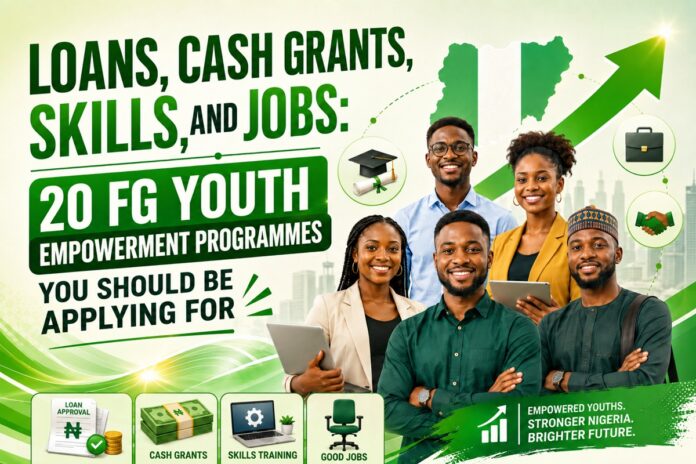
Loans, Cash Grants, Skills, and Jobs: 20 FG Youth Empowerment Programmes You Should Be Applying For in 2026

0
FG Youth Empowerment Programmes in Nigeria

If you are a young Nigerian trying to fund your education, learn a tech skill, land a job, or raise capital for a business, here is something you may not fully realise: the Federal Government currently runs more youth empowerment programmes than at any point in recent memory. Interest-free student loans, free skills training with monthly stipends, ₦1 million startup grants, digital work platforms, and multi-billion-naira entrepreneurship funds are all on the table right now and a surprising number of them go under-subscribed simply because eligible youth never hear about them or assume the process is too complicated.

The catch is that opportunity does not chase anybody. These schemes reward the youth who show up early, apply correctly, and keep their documents (NIN, BVN, JAMB number, passport photograph) ready.

This guide breaks down 20 active federal programmes what each one actually gives you, who qualifies, and how to get in. Bookmark it, share it, and treat it as a checklist. One of these could be the turning point in your career or business.

Quick note before you start: Government programmes open and close in cohorts, and figures like stipend amounts and slot numbers sometimes change between phases. Always confirm the latest requirements and deadlines on each programme’s official portal (listed under every section) before applying, and never pay anyone who claims they can “process” a free government programme for you.

You may also be interested in Freelancing: A Potential Solution for Unemployment.

1. Student Loan for Tertiary Education (NELFUND)

What it offers: The Nigerian Education Loan Fund (NELFUND) gives an interest-free loan to students in public tertiary institutions, covering tuition (paid directly to your school) plus an optional monthly upkeep allowance paid into your account. It exists so that no qualified Nigerian drops out of school because of money.

Who qualifies: You must be a Nigerian citizen enrolled in a federal or state university, polytechnic, monotechnic, or college of education (private-institution students are not covered as of 2026). You need a valid NIN and BVN, plus your JAMB registration number (fresh students) or matriculation number (returning students).

Crucially, your institution must first upload and verify your details on the NELFUND Student Verification Portal. If your school has not done this, contact your bursary, registry, or ICT unit before you apply. Applicants convicted of fraud, exam malpractice, or cultism, or who have defaulted on a previous loan, are disqualified.

Important to know: The loan is genuinely interest-free with no application fees. Repayment begins only after you graduate and complete NYSC, and once you have secured employment (typically structured as a modest salary deduction).

If you remain unemployed after service, you notify NELFUND periodically rather than being forced to pay. Apply early in the cycle, as institutional verification is the most common cause of “pending” delays.

Apply at: portal.nelf.gov.ng

2. Technical and Vocational Education and Training (TVET)

What it offers: Run by the Federal Ministry of Education, TVET offers tuition-free, hands-on training (roughly 90% practical, 10% theory) in over 25 in-demand trades like welding, electrical installation, fashion design, ICT, catering, and more, plus a monthly stipend, a nationally recognized certificate, and startup support on completion.

Who qualifies: It is open to virtually any Nigerian, with or without formal education, job seekers, school leavers, and graduates alike. You will need a valid NIN and BVN. There are two tracks: the Short-Term Certificate (STC) programme (about 6 months, no prior qualification required) and the Vocational Education & Innovation (VEI) programme (about 1 year, for those with some prior education or informal training who want to formalise their skills). Biometric attendance is required to receive stipends.

Important to know: The programme is funded through NELFUND, and the stipend is a grant, not a loan you do not pay it back. The stipend figure has been quoted as ₦45,000 in the original policy announcement, though some 2026 cohort communications reference ₦22,500, so confirm the current amount for your intake on the portal. Training is held at accredited centers across all six geopolitical zones.

Apply at: tvet.education.gov.ng

3. 3 Million Technical Talent (3MTT)

What it offers: A NITDA-led programme under the Federal Ministry of Communications, Innovation & Digital Economy aiming to train three million Nigerians in high-demand technical skills including software development, data analysis, data science, UI/UX design, product management, cybersecurity, cloud computing, AI/ML, and game development. Selected fellows get a fully funded scholarship, self-paced and applied learning, community support, and job-placement facilitation.

Who qualifies: Open to Nigerians with an interest in tech, from beginners to those with intermediate skills (some advanced tracks have prerequisites). Fellows are selected across all 36 states and the FCT, so location is not a barrier. Applications run in cohorts, so timing matters. Watch the portal for the next intake.

Important to know: Beyond training, 3MTT actively connects fellows to internships and jobs through its placement network of partner organisations, which is what makes it stand out from ordinary online courses. If you are serious about a tech career and cannot afford expensive bootcamps, this is one of the highest-value programmes on this list.

Apply at: 3mtt.nitda.gov.ng

4. Nigerian Youth Academy (NiYA) Startup Grants

What it offers: Under the Federal Ministry of Youth Development, NiYA provides seed funding to youth-led businesses in the form of ₦1 million grants for youth-led startups and ₦500,000 for informal-sector beneficiaries, alongside mentorship and enterprise support. The linked NiYA Startup Pitch programme has run competitive rounds offering millions in funding to selected founders.

Who qualifies: NiYA is generally open to Nigerian youth aged 18–35, with at least a secondary school certificate, who register on the NiYA platform. For the grant and pitch components, you typically need a genuine business or a scalable idea, a structured team, and a clear plan. Selection is competitive.

Important to know: Start by registering on the NiYA platform to access the wider ecosystem (free skills courses, community, jobs, and gigs), then apply to the specific funding call when it opens. Because grants are competitive and cohort-based, a well-prepared pitch and complete profile significantly improve your chances.

Learn more at: yid.fmyd.gov.ng/project-initiatives

5. NiYA Gigs Digital Work Platform

What it offers: A freelancing platform built specifically for Nigerian youth, connecting you to paid gigs from local and international clients while handling payments in a system tailored for Nigeria. It targets skills like writing, graphic design, programming, digital marketing, virtual assistance, and social media management.

Who qualifies: Any skilled young Nigerian who registers on the platform and creates a profile showcasing their services. There is no fee to join; your portfolio and skills are what win you work.

Important to know: Think of NiYA Gigs as a government-backed alternative to global freelance marketplaces, designed to remove the payment and access barriers Nigerian freelancers often face. Pair it with a skill acquired through 3MTT, TVET, or NiYA Academy and you have a direct path from training to income.

Learn more at: gigs.niya.gov.ng

6. Digital Literacy for All (DL4ALL)

What it offers: A national initiative, delivered in partnership with NITDA, working toward 70% digital literacy in Nigeria by 2027. It equips citizens with the essential digital skills needed to participate in today’s economy, from basic computer and internet use to more advanced digital competencies.

Who qualifies: Broadly open to Nigerians, with a particular focus on reaching youth and underserved communities. Training is designed to be accessible regardless of prior background.

Important to know: Even if you already consider yourself tech-savvy, DL4ALL is a useful gateway to more advanced programmes like 3MTT, because it builds and certifies the foundational skills employers increasingly expect. It also signals where the government is investing, so keep an eye on it for free training rollouts.

Learn more at: dl4all.nitda.gov.ng

7. Labour Employment and Empowerment Programme (LEEP)

What it offers: A Federal Ministry of Labour and Employment initiative aiming to create 2.5 million jobs through several pillars: a national job portal connecting seekers to employers, a digital academy for online skills, vocational and entrepreneurship training, global-workforce and migration pathways, and physical job fairs.

Who qualifies: Any Nigerian seeking employment, skills development, or entrepreneurship opportunities can register. It is one of the more open programmes on this list, with no narrow qualification barrier.

Important to know: Completing LEEP training earns you certificates you can showcase to employers, and the platform pairs participants with mentors. If your goal is a job (including access to global job markets) rather than a grant, LEEP’s job portal is a strong first stop.

Learn more at: leep.gov.ng

8. NDE Renewed Hope Employment Initiative (RHEI)

What it offers: Run by the National Directorate of Employment, RHEI delivers free vocational, digital, agricultural, and entrepreneurial training, along with a monthly stipend during training, a certificate of completion, starter packs (tools), and access to low-interest business loans. Earlier phases trained and resettled tens of thousands of youth nationwide.

Who qualifies: Broadly inclusive unemployed or underemployed Nigerians, typically aged 18–45, including school leavers, graduates, artisans, women, persons with disabilities (with reserved slots), and rural dwellers. You need a valid NIN and a passport photograph; no specific educational qualification is required for most tracks.

Important to know: Training centres are located in all 36 states and the FCT, so you can learn close to home. Applications run in phases with firm deadlines and high demand, so register early on the official portal and keep your dashboard and email active for shortlisting updates.

Learn more at: nde.gov.ng

9. CNG-Powered Tricycle Empowerment Scheme

What it offers: Also known as the Presidential initiative on CNG-powered Tricycles (Pi-CNG), it is a scheme aimed at distributing thousands of Compressed Natural Gas (CNG)-powered tricycles to Nigerian youth, tied to the government’s cheaper-transport and clean-energy agenda. Beneficiaries get an income-generating asset that runs on lower-cost fuel than petrol.

Who qualifies: Aimed at youth seeking a livelihood in transport. Requirements generally include valid identification and, in many rollouts, membership of a recognised transport union or cooperative, plus a commitment to the scheme’s repayment or hire-purchase terms where applicable.

Important to know: Because these are physical assets distributed in limited batches, allocation is often coordinated through state structures and unions. Confirm the current eligibility and any repayment model on the official channel, and go through recognised, official points of registration only.

Learn more at: youthcng.ng

10. Youth Investment Fund (YIF)

What it offers: A dedicated fund providing financial support to young Nigerian entrepreneurs to start or scale their businesses, part of the government’s broader push to move youth from job-seeking to job-creating.

Who qualifies: Aimed at young entrepreneurs with viable business ideas or existing small businesses. Specific eligibility (age band, business documentation, and required guarantees) is set per funding round, so check the portal for the active criteria.

Important to know: Funds like this typically require a registered business or a solid business plan, valid identification, and a bank account in the applicant’s or business’s name. Prepare these in advance so you can apply the moment a cycle opens.

Learn more at: nyif.nmfb.com.ng

11. National Youth Development Bank (NYDB)

What it offers: A financial institution established to give young entrepreneurs and innovators structured access to capital loans and financing designed around the realities of youth-led businesses rather than the strict collateral demands of conventional banks.

Who qualifies: Young Nigerian entrepreneurs and innovators. As with any lender, expect requirements around identification, business registration, or a bankable plan, and repayment capacity once the bank’s products are fully rolled out.

Important to know: The NYDB is part of the same ecosystem as NiYA and the Youth Investment Fund, so it is worth tracking all three together. Follow the official channel for product launches and application windows, and be wary of imitation “youth bank” schemes circulating on social media.

Learn more at: nydb.gov.ng

12. Yo! Health Youth Initiative

What it offers: A national campaign promoting health and wellness among young Nigerians, covering physical health, mental well-being, and healthy-lifestyle awareness, and creating avenues for youth to engage as participants and advocates.

Who qualifies: Open to Nigerian youth generally. Roles range from simply accessing health information and services to volunteering, advocacy, and ambassador-style participation.

Important to know: While it is not a cash-grant scheme, Yo! Health is valuable for youth interested in the health and development sector, offering exposure, networks, and volunteering experience that strengthen a CV. It also complements skills programmes by keeping the workforce healthy and informed.

Learn more at: yohealth.gov.ng

13. Ministry of Steel Development Youth Bootcamp

What it offers: A training bootcamp equipping young Nigerians with skills in metallurgy, industrial welding, and mechanical design, technical competencies directly tied to Nigeria’s push to revive its steel and heavy-industry sector.

Who qualifies: Youth interested in industrial and engineering trades. Specific entry requirements (age, minimum education, or aptitude screening) are set per cohort, so verify on the official channel before applying.

Important to know: This is a niche but high-value opportunity because industrial welding and metallurgy skills are in short supply and command strong pay, both locally and abroad. If you have an aptitude for hands-on technical work, this bootcamp can position you for well-paid roles in construction, manufacturing, and energy.

14. Nigeria Health Fellows

What it offers: A fellowship that trains and employs young Nigerians to strengthen the country’s healthcare workforce, having placed hundreds of youth into roles that support the health system.

Who qualifies: Typically aimed at young people with relevant health, science, or allied backgrounds, though specific tracks and entry criteria vary by cohort. Because it leads to employment, expect a competitive, structured selection process.

Important to know: Unlike training-only schemes, this fellowship pairs capacity-building with actual placement, making it especially attractive for health-sector graduates and aspirants. Watch the portal for open calls and prepare your credentials and CV to apply promptly.

Learn more at: healthfellows.ng

15. Reimagining Hope Creative Residency

What it offers: A residency programme empowering young Nigerian creatives across film, music, fashion, and tech, providing structured support, mentorship, and a platform to develop and showcase their work.

Who qualifies: Young creatives with demonstrable talent or projects in the target industries. Selection is usually portfolio- or project-based, so your body of work matters more than formal qualifications.

Important to know: Nigeria’s creative economy is one of its fastest-growing sectors, and residencies like this offer exposure and networks that are hard to buy. If you are a filmmaker, musician, designer, or creative technologist, prepare a strong portfolio and apply when the call opens.

16. NextGen Resilience Corps

What it offers: A youth mobilisation initiative focused on climate change, environmental sustainability, and local innovation engaging young people as active contributors to green projects and community-level solutions.

Who qualifies: Nigerian youth passionate about the environment, sustainability, and innovation. Participation may involve volunteering, project work, and skills-building around green solutions.

Important to know: “Green skills” and climate-focused experience are increasingly valued by employers, NGOs, and international programmes. Joining the Corps builds both impact and a differentiated profile, and can open doors to further climate-sector opportunities and funding.

17. Stockholm Junior Water Prize Nigeria

What it offers: The Nigerian arm of a prestigious international competition challenging teenagers to develop innovative solutions in water management and environmental sustainability, with winners advancing to represent Nigeria on the global stage.

Who qualifies: Nigerian teenagers (typically secondary-school-age students) with a research project or innovation addressing water and environmental challenges. Entry is project-based, so a well-documented, original idea is key.

Important to know: This is a standout opportunity for younger students who want international recognition, mentorship, and a serious line on their record before university. Teachers and school science clubs are often the best route in, so involve a mentor early.

18. SMEDAN Creative and Garment Studios

What it offers: Through the Small and Medium Enterprises Development Agency of Nigeria (SMEDAN), these studios empower young Nigerians in the creative economy and fashion industry with training, workspace, tools, and enterprise support to build viable businesses.

Who qualifies: Youth interested in fashion, garment-making, and creative enterprise. SMEDAN programmes generally favour applicants ready to run or grow a business, and may require business registration or a clear plan for the funded/supported tracks.

Important to know: SMEDAN is a long-standing agency with a track record of MSME support, which makes its youth-focused studios a comparatively established option. Explore its wider portfolio of grants, training, and business-formalisation services while you are on the portal.

Learn more at: smedan.gov.ng

19. NDDC Youth Entrepreneurship Fund

What it offers: The Niger Delta Development Commission has committed ₦30 billion to youth entrepreneurship in the Niger Delta region, aimed at funding and supporting young-led businesses across the oil-producing states.

Who qualifies: Youth from or operating in the Niger Delta region, with viable business ideas or existing enterprises. Expect requirements around identification, regional eligibility, and business documentation set per funding call.

Important to know: If you are based in the Niger Delta (including Rivers, Bayelsa, Delta, Akwa Ibom, Cross River, Edo, Abia, Imo, and Ondo), this is a region-specific fund worth prioritising, since competition is limited to a defined pool rather than the whole country. Confirm the active application window on the NDDC portal.

Learn more at: nddc.gov.ng

20. AfDB $100 Million Loan for Youth and Women-Led Enterprises

What it offers: A financing facility backed by the African Development Bank targeting tens of thousands of youth-led (and women-led) businesses with access to capital and business support, channelled through Nigerian financial partners.

Who qualifies: Youth- and women-led enterprises in Nigeria, typically accessed through participating banks or approved intermediaries rather than directly from AfDB. Standard requirements around business registration, financial records, and a fundable plan usually apply.

Important to know: Because this facility is disbursed via partner institutions, the practical step is to identify the participating Nigerian banks or programmes distributing it and apply through them. It is a reminder that some of the biggest capital pools for youth come through development-finance partnerships, not just direct government portals.

Learn more at: afdb.org

Conclusion: Opportunity Is Here — Your Move

Twenty programmes, one common thread: the Nigerian government and its partners are actively putting money, skills, tools, and jobs within reach of young people who are willing to apply. Whether your immediate need is funding your education (NELFUND), learning a paid skill (TVET, 3MTT, DL4ALL), earning online (NiYA Gigs, LEEP), raising business capital (NiYA grants, YIF, NYDB, NDDC, AfDB), or building a niche career in health, steel, the creative economy, or climate work, there is almost certainly an entry point on this list for you.

The youth who benefit are rarely the most connected or the most brilliant; they are the ones who prepare their documents early, apply the moment a cohort opens, follow instructions carefully, and refuse to pay touts for what is genuinely free. So pick two or three programmes that fit your goals, get your NIN, BVN, JAMB number, bank details, and passport photograph ready, and start today. And do one more thing: share this list. Somebody in your network is one application away from changing their story.


Jumia Still Owns Nigeria: Why 84% of Shoppers and 83% of Businesses Choose One Marketplace

0
Jumia still owns Nigeria

In most of the world, “online marketplace” means Amazon. In Nigeria, it means Jumia, and the gap is not close.

According to DHL eCommerce’s E-Commerce Trends Report 2026, which also ranks Nigeria 4th in the use of AI in Shopping, Jumia is the most popular online marketplace for both Nigerian shoppers and Nigerian businesses, used by 84% and 83% respectively. That dual dominance makes Nigeria one of a small handful of surveyed markets where a homegrown platform, rather than a global giant, sits at the centre of e-commerce on both sides of the transaction.

The report is based on responses from 29,000 shoppers and 5,800 businesses across 29 countries, gathered between December 2025 and February 2026, with 1,000 shopper respondents per market. Its country-level marketplace data tells a story about Nigeria that runs counter to the assumed direction of global e-commerce, and it comes with a warning attached.

One Platform, Both Sides of the Market

Jumia’s position in Nigeria is unusual precisely because it is balanced. Eighty-four percent of Nigerian shoppers name it as their most-used marketplace, and 83% of Nigerian businesses name it as their primary selling platform. Shopper demand and seller supply are pointing in the same direction.

That alignment matters more than the raw percentages. One of the report’s central themes is a persistent gap between where shoppers want to buy and where businesses choose to sell. Globally, the report finds that adoption of challenger platforms is accelerating faster than businesses are adapting, widening the gap between consumer behaviour and business focus. Nigeria does not have that problem with its lead marketplace. Sellers are where the buyers are.

How Nigeria Compares to the Rest of the World

Set against the global marketplace map, Nigeria’s Jumia loyalty looks distinctly regional rather than typical.

Amazon dominates most of the surveyed markets on both sides. It is the top platform for shoppers and businesses in the USA (85% / 87%), Canada (89% / 73%), the UK (87% / 78%), Germany (86% / 87%), the UAE (84% / 87%), India (94% / 94%) and Australia (68% / 92%), among others.

Where Amazon does not lead, the pattern is almost always the same: a strong local or regional player fills the gap. Nigeria’s Jumia sits alongside Takealot in South Africa (88% shoppers / 87% businesses), Mercado Libre in Argentina (93% / 98%), Shopee in Thailand (90% / 100%) and Malaysia (96% shoppers), Taobao in China (67% / 77%), and Allegro in Poland (89% / 92%).

This shows that this is part of a global pattern in which regional champions own markets that global platforms have not managed to dominate. Jumia’s advantage is built on the same foundations as those of other champions: local logistics, local payment processing, and a catalog tuned to the market it serves.

Nigerians Expect to Buy More on Marketplaces, Not Less

The forward-looking data suggests Jumia’s position is not a legacy habit fading out. It is strengthening.

Sixty-seven percent of Nigerian shoppers expect to buy more through online marketplaces over the next five years, one of the highest figures in the survey, and roughly double the global average of 34%. Only 6% expect to buy less. The appetite is not softening; it is intensifying.

Nigerian businesses see the same trajectory. Seventy-seven percent expect their customers to shop more on marketplaces over the coming five years, against a 54% global average, with just 3% expecting a decline. Both numbers rank among the strongest recorded in the study.

The report notes that, globally, marketplaces show the closest alignment between shopper and business expectations of any channel: 34% of shoppers versus 54% of businesses expect to use them more, making them, in DHL’s words, a strong foundation for growth. In Nigeria, both figures are far higher and even more tightly aligned, which points to marketplaces being the single most reliable channel for Nigerian e-commerce growth over the medium term.

The Broader Nigerian Marketplace Picture

Marketplaces do not operate in isolation in Nigeria, and the report is clear that they sit within an unusually multi-channel environment. Nigerian shoppers and businesses consistently outperform the global average across nearly every platform. The report explicitly groups Nigeria alongside Türkiye and Malaysia as markets that outperform the global norm across all channels.

Social commerce runs alongside the marketplace habit rather than competing with it: 86% of Nigerian shoppers buy through Facebook, well above the 63% global average. Apps are climbing too, with 66% of Nigerian shoppers expecting to buy more via apps over five years. And 58% expect to buy more from international retailers, against 45% globally.

For a platform like Jumia, this is both context and competition. The Nigerian shopper is not loyal to a single channel. They are loyal to convenience, and they move fluidly between marketplace, social feed and app depending on what is fastest.

The Warning Attached: Loyalty Ends at the Doorstep

Here, the report’s global findings complicate the comfortable narrative. Marketplace dominance does not insulate a platform from the two things Nigerian shoppers care about most: delivery and trust.

Seven in ten shoppers globally say they will not buy from a brand they do not trust to deliver, and the same proportion will abandon a cart if they are not offered the delivery and returns options they want at checkout.

In Nigeria specifically, delivery preferences are already diversifying: while 78% still opt for home delivery, 51% now return unwanted goods via parcel shops or convenience stores, and 15% via parcel lockers. The market is shifting toward out-of-home logistics faster than a home-delivery-only model can serve.

Muyiwa Adeseyoju, Country Manager of DHL Express Nigeria, put the underlying point directly, noting that delivery, trust and flexibility are no longer add-ons but central to customer experience, and that long-term growth depends on delivering consistently and building customer confidence.

For Jumia and its challengers, the implication is straightforward. Market share at the point of discovery is not the same as loyalty at the point of delivery. The platform that owns the Nigerian marketplace today will keep it only as long as it owns the last mile, and on that front, the report shows Nigerian shoppers are already exploring their options.

What This Means for Nigerian Retailers and Sellers

The strategic reading for anyone selling in Nigeria is that the marketplace channel is the safest bet for growth, and Jumia remains its centre of gravity. But three qualifiers apply.

First, a marketplace presence is necessary but not sufficient; the same shoppers who use Jumia are buying on Facebook and increasingly through apps, so a single-channel strategy leaves demand on the table.

Second, the growth is real and rising, with both shoppers and businesses expecting marketplace use to climb sharply over the next five years, so the window to establish a position is now, not later. Third, and most importantly, the competitive battleground is moving from discovery to fulfillment.

Nigerian shoppers have shown they will switch on delivery and returns, and no amount of marketplace share protects a seller who gets the last mile wrong.

Jumia owns Nigeria today. Whether it owns Nigeria in 2031 depends less on its catalog than on its logistics.

Source: DHL eCommerce, E-Commerce Trends Report 2026. Survey of 29,000 shoppers and 5,800 businesses across 29 countries, conducted December 2025 to February 2026.

TestMu AI Launches Kane CLI, the New Browser Automation Tool Built for AI Agents and Developers

0
Kane AI

TestMu AI (formerly LambdaTest), the world’s first full-stack Agentic Quality Engineering platform, today announced the launch of Kane CLI, a new browser automation tool that runs directly from the terminal.

Kane CLI is the first tool designed simultaneously for human developers and AI coding agents, closing the gap between code generation and verified browser execution.

AI coding agents have transformed how software gets written, as AI agents are shipping code faster than any QA team can click through flows manually. Features ship from prompts. Bugs get fixed in seconds. But the development loop has never fully closed: no agent can open a browser and verify that what it built actually works. That step still falls to a human. Kane CLI is built to close this loop.

Teams build features, spot bugs, ship code, and run agents. Kane CLI is the verification layer for all of it. Developers and QA engineers describe the flow and get pass or fail with a full step trace and screenshot before the PR goes up.

Designers and PMs verify fixes and broken flows without filing a ticket or waiting for a developer, then drop the shareable evidence link straight into Slack or Jira. And when AI agents like Claude Code, Codex CLI, Cursor, and Gemini CLI build a feature; Kane CLI is the missing tool that tells them whether it actually works in the local Chrome browser.

Key Capabilities of Kane CLI include:

  • Intent-based browser control: Operates purely on intent, requiring no selectors or underlying code.
  • Resilient runs: Kane CLI does not return halfway. It adapts and pushes through, up to 50 steps per flow, until the full journey is verified.Other tools break on the first change. Kane CLI finishes the run.
  • Playwright export: Converts plain English test flows into native Playwright test code with one command.
  • Automated bug discovery: Actively monitors and surfaces unexpected behaviors while the test flow is running.
  • Vision-based dynamic waiting: Detects loaders and animations on screen before acting. Not network-based. Handles canvas, Shadow DOM, and element frameworks that cannot be resolved.
  • Ask the tool for OTPs and CAPTCHAs: When an automated flow hits an OTP screen or a CAPTCHA, it does not fail silently. Kane CLI pauses, asks the human to handle that one step, and then continues the run. For AI agents, this is human-in-the-loop without stopping the entire workflow.
  • Two-way script migration: Convert existing Playwright or Selenium scripts to Kane CLI. Convert Kane CLI tests back to Playwright. No rewrite from scratch.
  • Inbuilt Test Manager sync: Every test case created locally is also saved remotely. Shareable proof attached automatically.
  • CI/CD ready: Runs headlessly in GitHub Actions, GitLab CI, Jenkins, and Bitbucket Pipelines. Standard exit codes plug into pipeline control flow without any custom scripting.
  • Contextual authoring: Give Kane CLI context about your app, and it authors parallel test cases across multiple browser sessions from a single prompt.

Three Ways to Run

Kane CLI ships with three modes so humans and agents can consume it the same way from the same terminal.

  • Interactive TUI – No arguments needed. A full terminal UI opens for exploring, iterating, and chaining tests across a live browser session.
  • Headless CLI – Add –headless for scriptable, display-free runs. Built for shell scripts and CI pipelines.
  • Agent Mode – Add –agent –headless. Outputs structured NDJSON that Claude Code, Codex CLI, and Gemini CLI read natively to decide what to do next.

Asad Khan, CEO & Co-Founder, TestMu AI, said,

“For years, the bottleneck in software was writing the code. Vibe coding removed that. Teams are shipping more software, faster, than at any point in the history of our industry. But it exposed a new bottleneck most teams haven’t named yet: trust. Every feature that ships from a prompt is a feature nobody has actually verified. At agentic speed, ‘a human will click through it later’ is not a plan — it’s a liability, compounding at the speed of AI. it’s a growing pile of unverified work. That’s why we built Kane CLI. One terminal command, a real browser, pass or fail. Software has always trusted the people who wrote it. Now, for the first time, it has to trust the machines. Kane CLI is how trust scales in the agentic era.”

As part of its launch, TestMu AI is offering bonus credits for the first three months to teams that activate a paid plan during the introductory period. The offer is designed to give engineering and quality teams full access to Kane CLI’s cloud capabilities.

Kane CLI is available today, free to start. Install via npm or brew, log in, and run your first flow.

Installation command for Kane CLI via npm – npm install -g @testmuai/kane-cli

Installation command for Kane CLI via Homebrew – brew install LambdaTest/kane/kane-cli

Or building with an AI agent? Point it to testmuai.com/kane-cli/agents.md

Also see: Exploring Codeless Automation Testing Tools: Revolutionizing Software Quality Assurance

Ranked 2026 Report Shows Nigeria’s Digital Media Traffic Drops 26% As AI Reshapes News Consumption

0
Ranked 2026 Report Shows Nigeria’S Digital Media Traffic Drops 26% As Ai Reshapes News Consumption

Nigeria’s digital media ecosystem recorded a 26.2% decline in total readership traffic in 2025, according to the newly released SquirrelPR RANKED 2026 Report, signalling a major shift in how audiences consume news and how influence is measured across the industry.

Total traffic across Nigerian digital media platforms fell from over 1.04 billion visits in 2024 to 769 million in 2025, marking one of the most significant structural changes in the country’s media landscape in recent years.

The report notes that this decline does not reflect reduced relevance, but a recalibration driven by artificial intelligence. AI-powered search overviews are increasingly answering user queries directly, reducing the need to visit publisher websites while still relying on those same publishers as primary sources.

“The old model of digital media was built on clicks. That model is breaking down,”

said Jonah Solomon, Co-founder of SquirrelPR.

“Today, influence is defined by authority, trust, and the ability to shape conversations—even when users don’t click through.”

Delivering the keynote address, Keni Akintoye, CEO and Lead Strategist at KT Communication, described the shift as a fundamental evolution in how influence is created and distributed.

“Influence has not declined—it has evolved,”

he said.

“People are still consuming content, but increasingly without arriving at the source. In that reality, traffic is no longer a complete measure of relevance. Trust is.”

He added that media platforms are transitioning from destinations to sources of authority within a broader information ecosystem, where credibility determines whether content is referenced and amplified.

The report highlights that domain authority and credibility are emerging as key indicators of influence, as high-authority platforms continue to dominate visibility in AI-driven discovery environments.

Across sectors, performance patterns vary. Legacy news platforms continue to dominate traffic and remain central to the information ecosystem powering search and AI systems. In business media, specialist platforms are gaining traction with more targeted, insight-driven content.

Technology media faces the most direct pressure from AI summarisation, while entertainment and lifestyle platforms remain relatively resilient due to their cultural and engagement-driven nature.

Insights from the panel session reinforced the shift away from volume-driven metrics. Múyiwa Mátuluko, CEO of Businessfront, said media organisations must prioritise depth and relevance over scale. Rasheed Bolarinwa, Group Head of Brand Marketing and Communications at Polaris Bank, noted that brands are increasingly focused on conversion, trust, and audience quality. 

From the newsroom perspective, Olufemi Ajasa, Online Editor of Vanguard, emphasised that credibility and quality journalism remain central to relevance. Damilola Bright-Ukwenga, a communications professional, highlighted the growing role of creators and micro-influencers in shaping narratives. Ifeanyi Abraham, PR Director at CIG Motors and moderator, described the shift as seismic, urging industry players to reposition for resilience.

The report concludes that traffic alone is no longer a sufficient performance metric, calling for a more strategic, authority-led approach to media visibility.

“PR can no longer be guesswork,”

Solomon added.

“You need data to understand which platforms truly shape perception.”

SquirrelPR also unveiled SquirrelPR 2.0, an AI-powered PR management platform built for Africa, and SMT Monitor, a media monitoring and social listening platform designed to support more data-driven communication strategies.

The RANKED 2026 Report positions Nigeria’s media landscape not as declining, but evolving into a more complex, AI-mediated ecosystem where trust, credibility, and influence matter more than ever.

The $40 Smartphone Revolution: Africa’s Digital Leap, But Are the Networks Ready?

0
Mobile

At Mobile World Congress 2026, a bold pledge was made: put a 4G smartphone in the hands of millions of Africans for just $40. The GSMA and the Handset Affordability Coalition unveiled an initiative that could rewrite the rules of digital access across the continent. The device price barrier? Nearly broken. But there’s a catch, one that no hardware discount can fix.

The network is the product.

And right now, the network tells a more complicated story.

Speeds That Can’t Keep Pace

nPerf’s 2025 data across three key African markets, Nigeria, Congo, and Ethiopia, reveals a landscape that is improving, but still far behind what most users in Europe or Asia take for granted.

Congo leads the pack with download speeds of 12.8 Mb/s, followed by Nigeria at 9.97 Mb/s, and Ethiopia bringing up the rear at a fragile 6.73 Mb/s, barely enough to stream standard-definition video without buffering.

For the millions of first-time smartphone users the $40 initiative aims to reach, this gap between device promise and network reality is not a footnote. It is the whole story.

Three Countries, Three Very Different Problems

What makes this data fascinating and sobering is that each country is struggling in its own distinct way.

Nigeria is the unlikely streaming champion of the three, posting the highest streaming performance index at 62.28%. Put on a YouTube video, and it’ll mostly hold together.

But try to browse a government portal, file an online form, or shop on an e-commerce site, and Nigeria’s web browsing score of just 27.36% tells you exactly what happens next: a spinning wheel and mounting frustration.

In a country where digital financial services and mobile commerce are rapidly expanding, that is a critical weakness.

Congo flips the script. It has the best latency of the group at 123 ms, meaning the network responds relatively quickly when you tap something.

But its streaming index of just 41.88% means video, increasingly the primary medium of education and entertainment for new internet users, remains a choppy, unreliable experience.

Ethiopia carries the heaviest burden of all. Its latency clocks in at a punishing 258 ms, more than double Congo’s, making video calls stutter, real-time apps lag, and interactive services feel broken. In a country where mobile internet is often the only internet, this isn’t a minor inconvenience. It’s a structural barrier.

The Congestion Trap And How to Escape It

Here’s the uncomfortable math behind the initiative: flooding a market with millions of new connected devices without strengthening the underlying infrastructure doesn’t create digital inclusion.

It creates digital disappointment. Congestion rises, speeds fall further, and the very people the program was designed to uplift end up with a device that underperforms.

But history offers a more hopeful counterargument. Demand, when it surges dramatically enough, has reliably pushed mobile operators to invest.

The GSMA is betting on exactly this dynamic that the sheer volume of new users created by the $40 smartphone will give operators both the incentive and the revenue base to upgrade their networks faster than they otherwise would.

It’s a calculated gamble, and not a crazy one.

What Needs to Happen

The roadmap differs by country, but the destination is the same. Ethiopia needs to address its latency problem without improvements there; no amount of affordable hardware will make video calls or real-time services workable.

Nigeria must shore up its browsing infrastructure, because a smartphone that can’t reliably load a webpage is a smartphone that can’t unlock the economic opportunities mobile connectivity promises. And Congo needs to invest in its streaming capacity, or risk becoming a country where people own 4G phones but can’t reliably watch a 4G video.

Three distinct diagnoses. One shared prescription: the network must keep pace with the device.

The Verdict

The $40 smartphone is a genuine breakthrough in device affordability, and the ambition behind the GSMA initiative is real. But the history of technology is littered with hardware solutions that arrived before the infrastructure could support them.

Africa’s mobile networks are not beyond rescue, far from it. They are already on a meaningful upward trajectory in many places.

The question is whether that trajectory is steep enough, and fast enough, to meet the moment. For the millions of people who will soon hold a $40 4G phone in their hands for the first time, the answer will not come from a press release at a conference in Barcelona.

It will come from whether the video loads.

PayPal Returns to Nigeria via Paga, Enabling Global Payments and Naira Withdrawals

0
PayPal Partners Paga in Nigeria

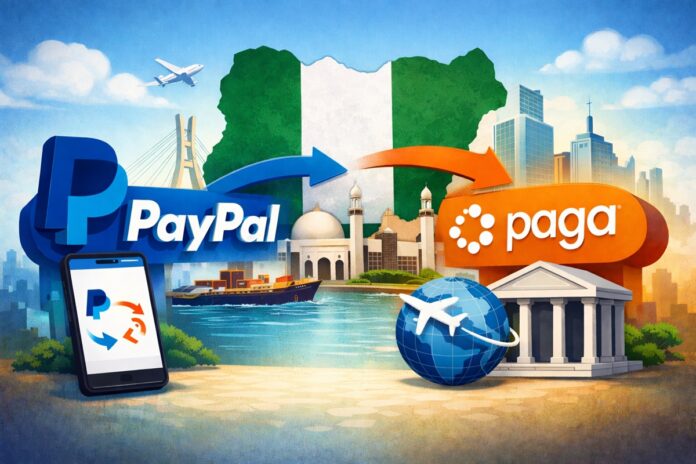
PayPal is expanding access for Nigerians to receive international payments through a new partnership with Nigerian fintech Paga, a move that could reshape how freelancers, creators, online sellers, and small businesses in Nigeria get paid from abroad.

With this integration, Nigerian users can link a PayPal account to a Paga wallet, receive cross-border payments via PayPal-supported markets, and withdraw funds locally in Naira or use them across Paga’s ecosystem.

What the PayPal–Paga Partnership Means for Nigerians

For years, PayPal’s experience in Nigeria was widely seen as limited, particularly in inbound payments. Nigerians could only spend with their PayPal accounts. You connect your card to your account and spend from it.

The wallet menu was not even available to users in Nigeria. However, with this announcement, we can now see that the wallet menu is available for Nigerian users.

With the Paga link now live, users can access features that make it easier to bring global earnings into the local economy, including withdrawals and everyday spending options.

With this PayPal-Paga partnership, Nigerians will be able to:

  • Receive international payments via PayPal
  • Withdraw locally in Naira through Paga
  • Shop with global PayPal merchants
  • Transfer to local bank accounts and pay bills/merchants within Paga

Paga Founder and Group CEO Tayo Oviosu described the rollout as a practical bridge between global income and local usage.

“We are proud to make this integration live and available to users across Nigeria,”

Oviosu said.

He added that the collaboration is designed to support a wide range of users, from freelancers to online businesses, who need reliable ways to access global funds locally.

On PayPal’s side, Otto Williams, Senior Vice President and Regional Head and General Manager for PayPal Middle East and Africa, said the company plans to deepen the experience over time:

“Over time, our goal is to make onboarding, settlement, and reconciliation even more seamless…”

Williams said.

Williams also framed the move as a deliberate partnership-led approach:

“We have been intentional about partnering with local innovators like Paga to develop solutions that help Nigerians earn, spend, and grow,”

he said.

How It Works

While product flows may evolve, the current setup centers on account linking:

  1. A user links their PayPal account to their Paga wallet.
  2. They can then receive international payments via PayPal which will be available in their PayPal wallet.
  3. Funds can be withdrawn in Naira and used for payments, transfers, and spending within Paga.

I also suspect that, while the balance is in the PayPal wallet, the user can use it to make PayPal payments directly, such as paying for subscriptions. However, I have not yet been able to confirm this. This will be clearer in the coming days and weeks.

Why This Matters Now

Nigeria has one of Africa’s largest pools of digital talent and online commerce activity, but cross-border collection has often been a pain point for individuals and smaller businesses. By combining PayPal’s global payment capabilities with Paga’s local wallet and settlement capabilities, the partnership aims to reduce friction for inbound payments and local access to funds.

As the integration rolls out, industry watchers will be looking at adoption rates, user experience, fees, and how quickly additional features, particularly for merchants, are added.

We also hope this lasts longer than PayPal’s 2021 partnership with Flutterwave.

Counterfeit LG TVs Circulating in Alaba Market, other Markets in Nigeria – LG Electronics Nigeria

0
Counterfeit LG TVs Circulating in Alaba Market, other Markets in Nigeria

LG Electronics Nigeria is urgently alerting the public of counterfeit LG televisions currently circulating in the market, following disturbing online videos showing unauthorized individuals packaging non-LG TVs in fake LG cartons and labels.

The statement highlights the recent surge in counterfeit LG televisions being circulated in Alaba Market and other markets across Nigeria, a story that has already gained significant online attention. LG has also provided a few tips to help consumers identify original LG TVs.

These counterfeit products are not manufactured or distributed by LG Electronics Nigeria or any of our approved partners. They present serious risks to consumers, including substandard performance, electrical hazards, and the complete absence of an LG warranty or support.

“We are deeply concerned by the spread of these counterfeit TVs and the potential harm to Nigerian families. At LG, consumer safety and product quality are our top priorities. We remain dedicated to providing our customers with genuine products and ensuring their peace of mind,”

said Moses Osime, Public Relations Manager, LG Electronics Nigeria.

How to Buy Original LG TVs:

  • Only buy LG TVs from authorized LG dealers and retail outlets.
  • Check for original LG factory seals, correct model details, serial numbers, and official warranty cards.
  • If a price seems too good to be true, it probably is.
  • Register and verify your LG product at https://www.lg.com/africa/support/product-validation or contact our customer service team.

LG Electronics Nigeria appreciates its customers’ vigilance and trust. The company is committed to keeping the public informed, supporting Nigerian families, and upholding the highest standards of quality, safety, and trust. We encourage the public to always stay alert and make informed decisions when purchasing electronics.

Also see How to Get your Tax ID with your NIN

How to Get your Tax ID with your NIN

0
How to Get a Tax ID with NIN

2026 is the year more Nigerians will start paying tax (especially income taxes) as the government, via the NRS (Nigeria Revenue Service) and the JRB (Joint Revenue Board), commences full implementation of the new tax laws from January 1, 2026. One of the first steps to being tax-compliant in Nigeria is obtaining a tax ID. In this article, I will provide a step-by-step guide on how to get your tax ID with your NIN (National Identification Number). I will also highlight how businesses, organisations, government ministries/agencies, and non-residents can obtain their Tax IDs.

What is Tax ID?

Tax ID is a unique 13-digit number that identifies a taxpayer in Nigeria. It is used to identify individuals, businesses, organisations, government ministries/agencies, and non-residents for tax administration, compliance, and enforcement.

It will run simultaneously with existing tax identification systems, like the TIN (Tax Identification Number), but would likely phase them out in the future.

The Tax ID is designed to be unique for each individual and entity, reducing duplication, fraud, and identity mismatches.

It also enables smoother interactions across banks, employers, regulators, and government agencies, while supporting more efficient tax assessment, filing, and ongoing compliance monitoring.

How to Get your Tax ID with your NIN

Your Tax ID is linked to your NIN. The Joint Revenue Board and the Nigeria Revenue Service have created a portal to enable individuals, businesses, government agencies, and non-residents to retrieve their Tax ID. Here is the step-by-step guide for obtaining your Tax ID with your NIN as an individual.

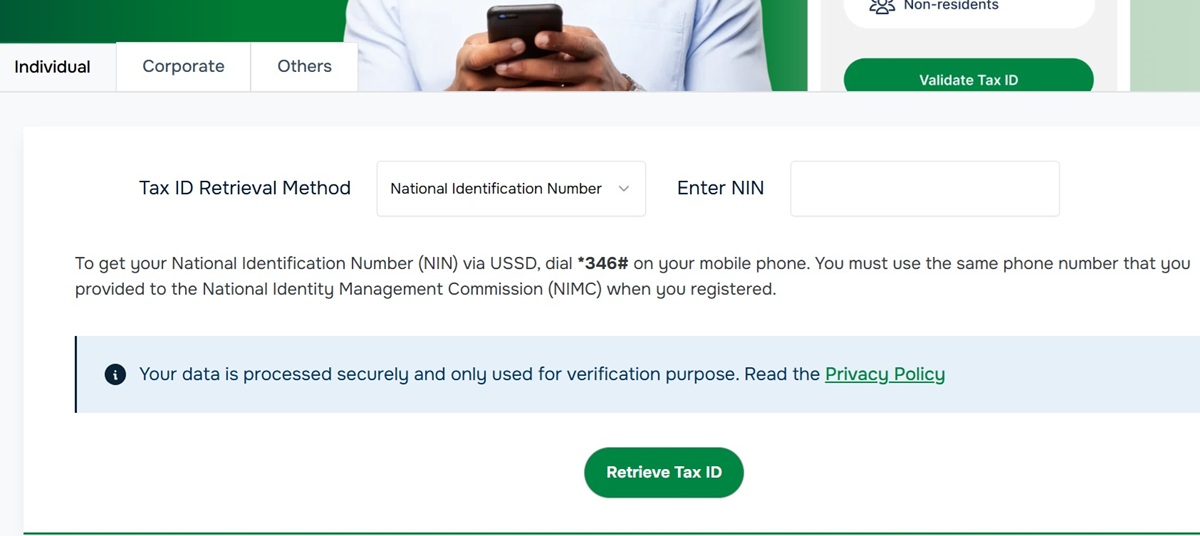
1. Visit taxid.firs.gov.ng or taxid.jtb.gov.ng: Using your mobile phone or computer, visit the NRS or JRB tax ID portals at taxid.firs.gov.ng or taxid.jtb.gov.ng, respectively. This will open a page requiring you to enter your NIN.

Choose Tax ID Retrieval Method

2. Enter your NIN: You can just type in your NIN in the field provided. If you cannot remember your NIN, you can dial *346# to retrieve it at a cost of 20 Naira. There is also an option to use the NINAuth share code, a one-time secure code generated from the NIMC NINAuth App. If you prefer to use the NINAuth share code, change the Tax Retrieval Method from National Identification Number to NINAuth share code and enter the code generated from the NIMC NINAuth App.

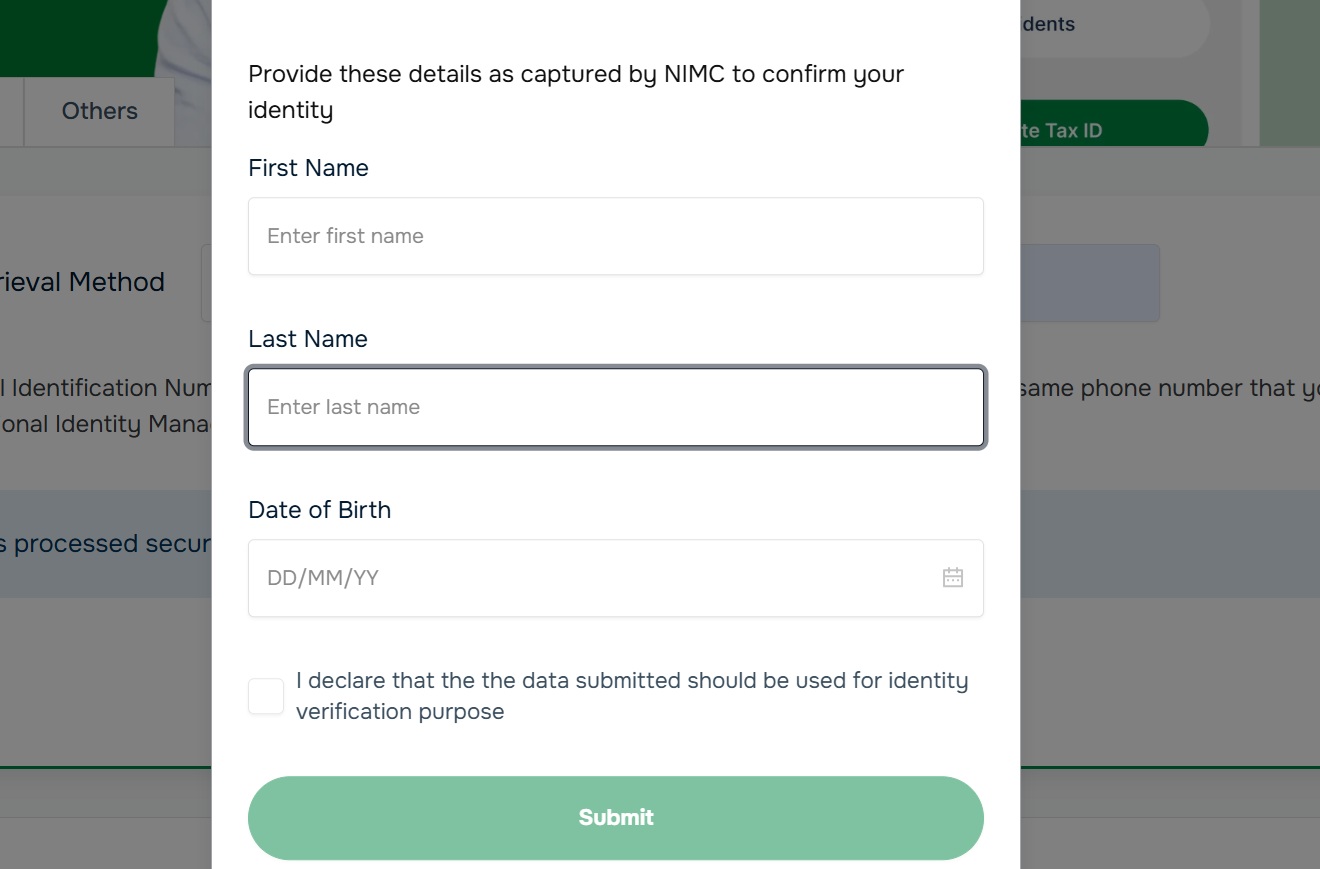
3. Click the Retrieve Tax ID Button: Click or tap the Retrieve Tax ID button. A form will open requesting your name and date of birth.

Confirm your Identity for Tax ID

4. Enter your First Name and Last Name: Type in your first name and last name in the appropriate fields on the form. Please make sure your entry matches your NIN entry.

5. Enter your Date of Birth: Select your date of birth. Also, make sure that the date you enter matches what is in the NIN database.

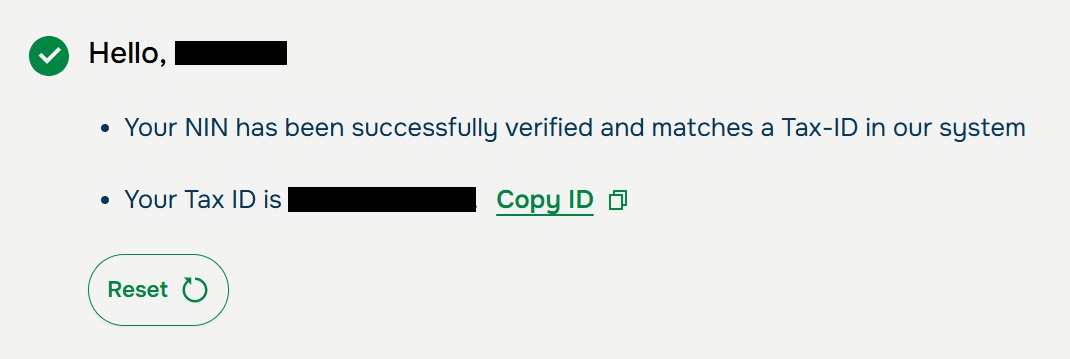
6. Click the Submit Button: Click or tap the Submit button. If the process is successful, your Tax ID will be displayed with the message format below:

Hello, [Your First Name]

Your NIN has been successfully verified and matches a Tax-ID in our system.

Your Tax ID is [Your 13-digit Tax ID]

View your Tax ID in Nigeria

7. Copy or Screengrab your Tax ID: Click the Copy ID link to copy your Tax ID, then paste and save it in a secure location on your mobile phone or computer. You can also just write it down in your diary or jotter for future reference. In the future, the NRS and JRB may provide a USSD code that will enable you to retrieve your Tax ID on your phone just like NIN and BVN.

Also see the Best Accounting Software.

How to Obtain a Tax ID for Businesses and Organizations

While NIN is required to retrieve the Tax ID for an individual, the company or organization number issued by CAC (Corporate Affairs Commission) is required to retrieve the Tax ID for businesses and organizations registered as Business Name, Company, Incorporated Trustee, Limited Partnership, and Limited Liability Partnerships.

The portal is set to default to Individual. To retrieve the Tax ID for a Company, Business Name, Incorporated Trustee, Limited Partnership, or Limited Liability Partnerships, you have to select Corporate and select the type of business or organization incorporation, and then enter the CAC ID number for the business or organization and click the Retrieve Tax ID button.

You may also be interested in MTN MoMo Bill Payment, and 9Mobile rebrands to T2 Mobile.