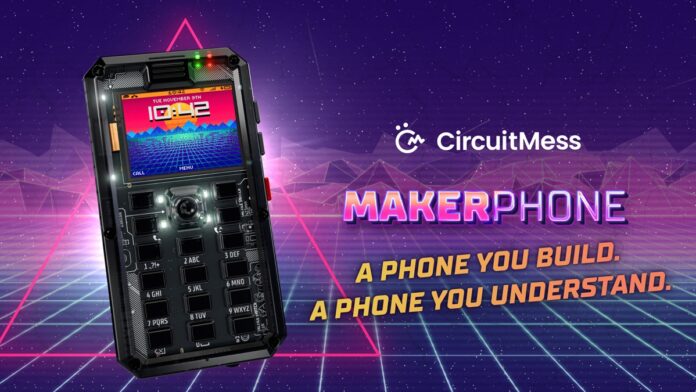

CircuitMess has launched MAKERphone 2.0 on Kickstarter, and the campaign is already more than nine times funded with three weeks still to run. The pitch is unusual enough to explain the response. This is a real 4G mobile phone that arrives in a box of parts. You assemble it yourself in about two hours, slot in a nano-SIM, and it makes calls and sends texts on live cellular networks. Then you program it, starting by describing what you want in plain English.
The campaign went live on 10 September 2026 with a $30,000 goal. According to Croatian tech outlet Bug.hr, that goal was met in the first 49 minutes and cleared five times over within a day. Kickstarter’s own campaign page now shows the project is past 900 percent of target, with roughly 25 days left before it closes in mid-October.
This sequel is eight years in the making. The original MAKERphone, later known as Ringo, raised over $324,000 in 2018 from 2,154 backers and shipped to more than 6,000 people, but it asked each of them to spend about seven hours with a soldering iron.
No soldering: the change that matters most
The single biggest difference in version 2.0 is that the soldering iron is gone.
Every component now clicks, screws or plugs into place. CircuitMess supplies a LEGO-style illustrated manual plus video guides, and puts the full build at roughly two hours with no prior experience needed. The kit contains everything: PCB, display, 12-key numpad, joystick, battery, casing and the remaining hardware.
That drop from seven hours of soldering to two hours of assembly is what turns the MAKERphone from a maker project into something a nine-year-old can finish on a Saturday afternoon, which is precisely the audience CircuitMess is chasing this time.
MAKERphone 2.0 Specs
| Component | Specification |
|---|---|
| Processor | ESP32-S3, dual-core, 4 MB flash, 4 MB PSRAM |
| Cellular | 4G LTE Cat-1 with 2G fallback, nano-SIM |
| Display | 1.77-inch colour, 160 × 128 pixels |
| Input | 12-key numpad, navigation joystick, 4 function keys, power key, volume rocker |
| Audio | DAC and speaker, I²S microphone, 3.5 mm headphone jack |
| Battery | 1,000 mAh, USB-C charging |
| Storage | microSD card slot |
| Connectivity | WiFi, Bluetooth, USB (charging and programming over one cable) |
| Expansion | UMAX modular connector, six add-on modules, auto-detected |
| Extras | Programmable RGB LEDs, real-time clock |
| Dimensions | 11.5 × 6 × 1.8 cm |
| Weight | 104 g assembled |
The ESP32-S3 at the center of it is an Arduino-compatible microcontroller, not a smartphone chip, and CircuitMess is not pretending otherwise. Keeping the headphone jack in 2026 is a deliberate wink at the audience.
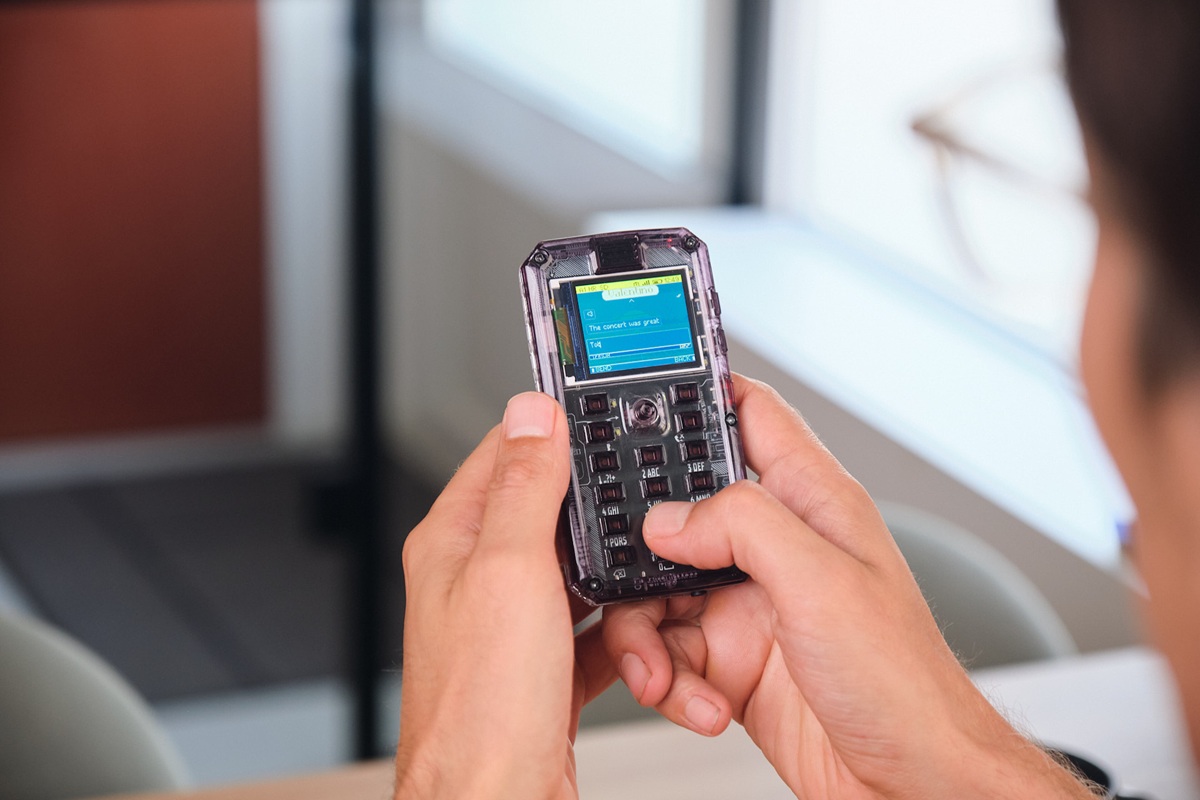
Out of the box the assembled phone handles calls, SMS, contacts, call history, ringtones, alarms, calendar, notes, a music player with playlists, a photo and video gallery, a file explorer and more than 10 built-in retro games.
Six snap-on modules that add their own apps
The UMAX expansion port takes six add-on modules: Camera, Big Speaker, Flashlight, Environment (temperature and humidity), Infrared, and a DIY Perf Board for soldering your own circuits if you want to go further.
Plug one in, and the phone detects it automatically, then adds the matching app to the menu without any setup. The base kit doesn’t include any modules; they are sold separately.
VibeBoy: coding that starts in plain English
The software side is where MAKERphone 2.0 makes its boldest claim. Programming happens through VibeBoy, CircuitMess’s AI-assisted coding studio, available at vibeboy.com.
You describe an idea in plain English; the company’s own example is “make me a game where a taco dodges falling pickles.” Watch AI generate the code, then push it to the phone in one click. From there, you are expected to open that code, learn to read it, fix what is broken, and eventually write your own.

CircuitMess structures this as a four-rung ladder: Pixel Rookie (ages 9+), Signal Hacker (11+), Modder (14+) and Vibe Coder (any age), ending with writing MicroPython and Arduino C++ from a blank file.
“VibeBoy is not autocomplete,” the company insists in its press materials, framing it as a tool that teaches users to think with AI rather than outsource to it, how to describe a problem, read what the model produced, and correct it when it is wrong.
Every MAKERphone 2.0 includes three months of unlimited VibeBoy AI usage and a free tier for life. The Pro tier costs $4.99 a month afterwards.
A first phone with no app store
CircuitMess is pitching MAKERphone 2.0 hard at parents, and the positioning is sharp: a phone that calls and texts the people a child needs, with no social media, no app store, and no infinite feed. When a kid wants a new app, they build it.
The company’s line for it is that MAKERphone 2.0 doesn’t fight screen time; it turns it into create time.
That lands at a useful moment. Governments across Australia, France, the UK, and several US states have moved to restrict phones in schools and tighten social media age limits, and the minimalist phone category- Light Phone, Punkt, Pinwheel, the Nokia feature phone revival has grown on exactly that anxiety.
MAKERphone 2.0 arrives at the same problem from the opposite direction: instead of selling subtraction, it sells construction.
There is a companion device too. The optional MAKERband is a buildable, programmable smartwatch running an ESP32-C3 with a 0.96-inch colour display, 15 watchfaces, five mini-games and phone notifications. It pairs over Bluetooth 5.0 with the MAKERphone, but also with iOS and Android. Schools get a Classroom Pack: 10 phones, 10 MAKERbands and 10 module packs.
MAKERphone 2.0 price and release date
CircuitMess lists early-bird pricing from $109 in its press materials, with reporting from It’s FOSS putting the earliest tiers at $119 and an eventual retail price of $169. Tiers climb from there depending on bundle, and the cheapest ones typically sell out early on campaigns like this.
Shipping is worldwide. Backer deliveries are estimated for Q3 2027, about a year after the campaign closes, with general retail availability after backers are fulfilled.
That wait is the main thing to weigh. The counterweight is CircuitMess’s record: founded in Karlovac, Croatia in 2017 by Albert Gajšak, the company has shipped more than 300,000 kits to customers in over 100 countries, developed 37 products, and raised over $2.2 million across six previous Kickstarter campaigns every one of them delivered. That is a materially better track record than most hardware crowdfunding, though it is never a guarantee.
CircuitMess also says this is not a prototype pitch. The hardware design is finished and final production hardware exists; the software is feature-complete and in final testing. The money raised funds manufacturing at scale rather than R&D.
“The original MAKERphone taught thousands of kids that a phone isn’t magic, it’s parts and code, and both can be mastered,”
said Albert Gajšak, founder and CEO of CircuitMess.
“MAKERphone 2.0 takes away everything that used to stand in the way.”
Should you back it?
MAKERphone 2.0 is not competing with a smartphone, and buying it as one would be a mistake. A 160 × 128 display and 4 MB of flash set hard limits on what it can do.
What it is competing with is a STEM kit, a coding course, and a locked-down kids’ phone all three at once for roughly the price of one. If that combination appeals, and an 18-month wait from today does not put you off, the early-bird tiers are the cheapest this will ever be.
The campaign runs until mid-October on Kickstarter.
MAKERphone 2.0 FAQ
Is MAKERphone 2.0 a real phone? Yes. It takes a nano-SIM and makes voice calls and sends SMS over 4G LTE Cat-1 networks, with 2G fallback where LTE is unavailable.
Do I need to know how to solder? No. Every part clicks, screws or plugs together. Assembly takes around two hours with an illustrated manual and video guides. Only the optional DIY Perf Board module involves soldering.
What age is MAKERphone 2.0 for? CircuitMess sets the floor at 9+ for the entry-level Pixel Rookie tier, with the learning ladder running up through 11+, 14+ and an open-ended top level for adults.
What languages can you program it in? Plain English through VibeBoy’s AI studio, then MicroPython and Arduino C++ directly.
How much does MAKERphone 2.0 cost? Early-bird pledges start at $109 according to CircuitMess, with reported entry tiers at $119 and an expected retail price of $169 after the campaign.
When will MAKERphone 2.0 ship? Backer deliveries are estimated for Q3 2027. Retail availability follows backer fulfilment.
Does it run Android apps? No. It runs CircuitMess’s own firmware on an ESP32-S3 microcontroller. There is no app store — you write the apps yourself.