
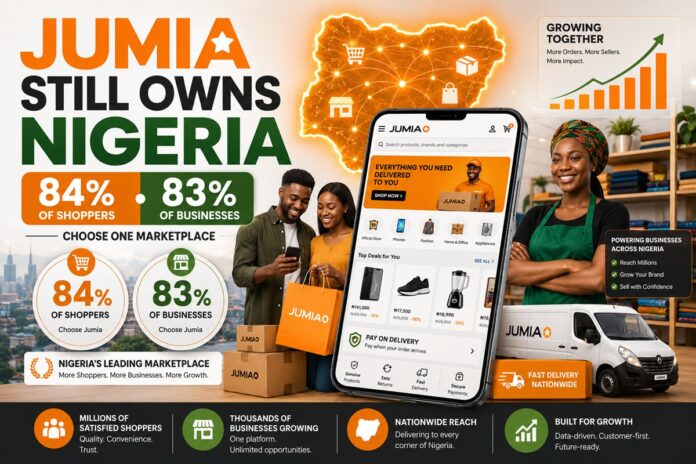

In most of the world, “online marketplace” means Amazon. In Nigeria, it means Jumia, and the gap is not close.
According to DHL eCommerce’s E-Commerce Trends Report 2026, which also ranks Nigeria 4th in the use of AI in Shopping, Jumia is the most popular online marketplace for both Nigerian shoppers and Nigerian businesses, used by 84% and 83% respectively. That dual dominance makes Nigeria one of a small handful of surveyed markets where a homegrown platform, rather than a global giant, sits at the centre of e-commerce on both sides of the transaction.
The report is based on responses from 29,000 shoppers and 5,800 businesses across 29 countries, gathered between December 2025 and February 2026, with 1,000 shopper respondents per market. Its country-level marketplace data tells a story about Nigeria that runs counter to the assumed direction of global e-commerce, and it comes with a warning attached.
One Platform, Both Sides of the Market
Jumia’s position in Nigeria is unusual precisely because it is balanced. Eighty-four percent of Nigerian shoppers name it as their most-used marketplace, and 83% of Nigerian businesses name it as their primary selling platform. Shopper demand and seller supply are pointing in the same direction.
That alignment matters more than the raw percentages. One of the report’s central themes is a persistent gap between where shoppers want to buy and where businesses choose to sell. Globally, the report finds that adoption of challenger platforms is accelerating faster than businesses are adapting, widening the gap between consumer behaviour and business focus. Nigeria does not have that problem with its lead marketplace. Sellers are where the buyers are.
How Nigeria Compares to the Rest of the World
Set against the global marketplace map, Nigeria’s Jumia loyalty looks distinctly regional rather than typical.
Amazon dominates most of the surveyed markets on both sides. It is the top platform for shoppers and businesses in the USA (85% / 87%), Canada (89% / 73%), the UK (87% / 78%), Germany (86% / 87%), the UAE (84% / 87%), India (94% / 94%) and Australia (68% / 92%), among others.
Where Amazon does not lead, the pattern is almost always the same: a strong local or regional player fills the gap. Nigeria’s Jumia sits alongside Takealot in South Africa (88% shoppers / 87% businesses), Mercado Libre in Argentina (93% / 98%), Shopee in Thailand (90% / 100%) and Malaysia (96% shoppers), Taobao in China (67% / 77%), and Allegro in Poland (89% / 92%).
This shows that this is part of a global pattern in which regional champions own markets that global platforms have not managed to dominate. Jumia’s advantage is built on the same foundations as those of other champions: local logistics, local payment processing, and a catalog tuned to the market it serves.
Nigerians Expect to Buy More on Marketplaces, Not Less
The forward-looking data suggests Jumia’s position is not a legacy habit fading out. It is strengthening.
Sixty-seven percent of Nigerian shoppers expect to buy more through online marketplaces over the next five years, one of the highest figures in the survey, and roughly double the global average of 34%. Only 6% expect to buy less. The appetite is not softening; it is intensifying.
Nigerian businesses see the same trajectory. Seventy-seven percent expect their customers to shop more on marketplaces over the coming five years, against a 54% global average, with just 3% expecting a decline. Both numbers rank among the strongest recorded in the study.

The report notes that, globally, marketplaces show the closest alignment between shopper and business expectations of any channel: 34% of shoppers versus 54% of businesses expect to use them more, making them, in DHL’s words, a strong foundation for growth. In Nigeria, both figures are far higher and even more tightly aligned, which points to marketplaces being the single most reliable channel for Nigerian e-commerce growth over the medium term.
The Broader Nigerian Marketplace Picture
Marketplaces do not operate in isolation in Nigeria, and the report is clear that they sit within an unusually multi-channel environment. Nigerian shoppers and businesses consistently outperform the global average across nearly every platform. The report explicitly groups Nigeria alongside Türkiye and Malaysia as markets that outperform the global norm across all channels.
Social commerce runs alongside the marketplace habit rather than competing with it: 86% of Nigerian shoppers buy through Facebook, well above the 63% global average. Apps are climbing too, with 66% of Nigerian shoppers expecting to buy more via apps over five years. And 58% expect to buy more from international retailers, against 45% globally.
For a platform like Jumia, this is both context and competition. The Nigerian shopper is not loyal to a single channel. They are loyal to convenience, and they move fluidly between marketplace, social feed and app depending on what is fastest.
The Warning Attached: Loyalty Ends at the Doorstep
Here, the report’s global findings complicate the comfortable narrative. Marketplace dominance does not insulate a platform from the two things Nigerian shoppers care about most: delivery and trust.
Seven in ten shoppers globally say they will not buy from a brand they do not trust to deliver, and the same proportion will abandon a cart if they are not offered the delivery and returns options they want at checkout.
In Nigeria specifically, delivery preferences are already diversifying: while 78% still opt for home delivery, 51% now return unwanted goods via parcel shops or convenience stores, and 15% via parcel lockers. The market is shifting toward out-of-home logistics faster than a home-delivery-only model can serve.
Muyiwa Adeseyoju, Country Manager of DHL Express Nigeria, put the underlying point directly, noting that delivery, trust and flexibility are no longer add-ons but central to customer experience, and that long-term growth depends on delivering consistently and building customer confidence.
For Jumia and its challengers, the implication is straightforward. Market share at the point of discovery is not the same as loyalty at the point of delivery. The platform that owns the Nigerian marketplace today will keep it only as long as it owns the last mile, and on that front, the report shows Nigerian shoppers are already exploring their options.
What This Means for Nigerian Retailers and Sellers
The strategic reading for anyone selling in Nigeria is that the marketplace channel is the safest bet for growth, and Jumia remains its centre of gravity. But three qualifiers apply.
First, a marketplace presence is necessary but not sufficient; the same shoppers who use Jumia are buying on Facebook and increasingly through apps, so a single-channel strategy leaves demand on the table.
Second, the growth is real and rising, with both shoppers and businesses expecting marketplace use to climb sharply over the next five years, so the window to establish a position is now, not later. Third, and most importantly, the competitive battleground is moving from discovery to fulfillment.
Nigerian shoppers have shown they will switch on delivery and returns, and no amount of marketplace share protects a seller who gets the last mile wrong.
Jumia owns Nigeria today. Whether it owns Nigeria in 2031 depends less on its catalog than on its logistics.
Source: DHL eCommerce, E-Commerce Trends Report 2026. Survey of 29,000 shoppers and 5,800 businesses across 29 countries, conducted December 2025 to February 2026.